The sugar-cane: a poem in four books with notes / [James Grainger].
- James Grainger
- Date:
- 1766
Licence: Public Domain Mark
Credit: The sugar-cane: a poem in four books with notes / [James Grainger]. Source: Wellcome Collection.
30/200 page 16
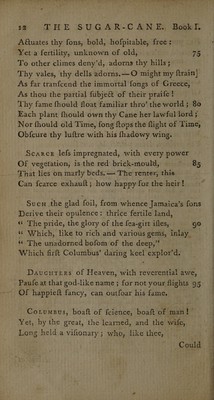
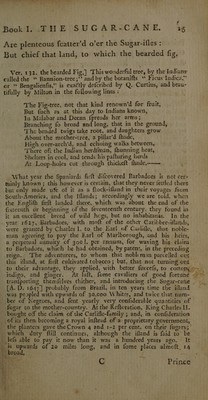
![' Prince of the foreft, save Barbadoes name 3_ Chief Nevis, juftly, forts hot baths fam’d> » And _ breezy ~Mountferrat, whofe wonderous fprings CUO ORR FLAS Lise Change, like Medufa’s head, whate’er they touch, To ftony hardnefs; boaft this fertile glebe. Wer. 134. Chief Nevis,} This ifland which does not contain many fewer {quare miles than St. Chriftopher, is more rocky, by a channel not above one mile and an half over, and lies to the hot well at Briftol, and its water; being properly bottled, keeps as well at fea, and is no lefs agreeable to the palate. It was for many years the capital of the Leeward Ifland govern- ment; and, at that period, contained both more Whites, and wards, the chief town was almoft wholly deftroyed by an earth- quake; and, 1706, the planters were well-nigh ruined by the ¥rench, who carried off their flaves contrary to capitulation. It muft have been difcovered in Columbus’s facil voyage, A. D, *493¢ Ver. 13g. And breezy Mountferrat,] This ifland, which lies about 30 miles to the <fouth-weft of Antigua, is not lef$ famous for folfaterre (or volcano), and hot petrifying fpring, than for the goodnefs of its fugars. _ Being almoft circular in its fhape, it «cannot contaitt much lefs land than either Nevis or St. Chrif- topher, It is naturally ftrong, fo that when the French made defcents thereon, in K. William’s and Q: Anne’s time, they were always repulfed with confiderable lofs. It was fettled by that great adventurer Sir Thomas Warner, A. D. 1632, who Sent thither fome of his people from St. Chriftopher, for that purpofe. In the beginhing of the reign of Charles II.~ the French took it, but it was reftored, A.D. 1657, by the treaty -well when our enemiés attempted to conquer it, have many privileges, and of courfe are more numerous there, than im any Plymouth, Columbus difcovered it in his fecond voyage. . a Ld](https://iiif.wellcomecollection.org/image/b3299817x_0030.jp2/full/800%2C/0/default.jpg)




 No text description is available for this image
 No text description is available for this image
 No text description is available for this image