The sugar-cane: a poem in four books with notes / [James Grainger].
- James Grainger
- Date:
- 1766
Licence: Public Domain Mark
Credit: The sugar-cane: a poem in four books with notes / [James Grainger]. Source: Wellcome Collection.
57/200 page 43
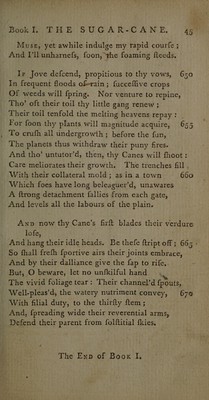
![Beyond the with of avarice, paid his toil. No cramps, with fudden death, furpriz’d his mules ; 615 No glander-peft his airy ftables thinn’d : And, if diforder feiz’d his Negroe-train, Celfus was call’d, and pining Illnefs flew. His gate ftood wide to all; but chief the poor, The unfriended ftranger, and the fickly, fhar’d 620 His prompt munificence: No furly dog, Nor furlier Zthiop, their approach debar’d. = * The Mufe, that pays this tribute to his fame, Oft hath efcap’d the fun’s meridian blaze, Beneath yon tamarind-vifta, which his hands 625 © Planted ; and which, impervious to the fun, His latter days beheld. — One noon he fat Beneath its breezy fhade, what time the fun His fultry vengeance from the Lion pour’d ; And calmly thus his. eldeft hope addrefs’d. 630 ~ large fly, which the French call Mouche a caffe; as well as by the white grub, which they name Puceron, Its medical and alimen- ‘tary qualities are as generally known as to thoie of tea, Ver. 625. tamarind-vifta,]_ This large, thady, and beautiful tree grows faft even in the drieft foils, and lafts long; and yer its wood: is hard, and very fit for mechanical ufes. The leaves are {maller than thofe of fenna, and pennated; they tafte fourifh, as does the pulp, which is contained in pods four or five iaches Jong, They bear once a year, An excellent vinegar may be made from the fruit; but the Creoles chiefy. preierve it with fugar, as the Spaniards with falt. A pleafant fyrup may be made from it. The name is, in Arabic, Tamara. ‘The Antients were “not acquainted therewith 5° for the Arabians firft introduced ta- _ foarinds into phyfic; it is a native of the Eaft as well as of the _ Weft-Indies and South-America, where different’ provinces call ix | by different names. Its cathartic qualities are'well known. Itis © good in fee-ficknets, The botanical name is Tamarindus. eh ws E 3 $F Br](https://iiif.wellcomecollection.org/image/b3299817x_0057.jp2/full/800%2C/0/default.jpg)
 No text description is available for this image
 No text description is available for this image
 No text description is available for this image