Licence: Public Domain Mark
Credit: The British grasses and sedges / by Anne Pratt. Source: Wellcome Collection.
Provider: This material has been provided by Royal College of Physicians, London. The original may be consulted at Royal College of Physicians, London.
199/224 (page 123)
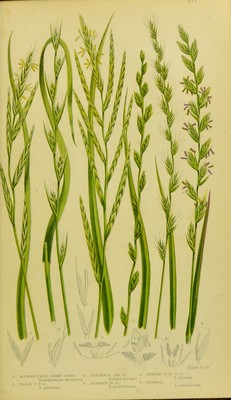
![course of a few minutes. It grows chiefly on sandy soils. (PI. 269, fig. 6.) 4. H. maritimum (Sea-side Barley).—Spike compact, erect; ghmes rough, the inner one of the lateral spikelets half egg-shaped, the rest bristle-shaped and rough ; awn of the outer glumella in the middle spikelet more than twice as long as the awn of the lateral ones; middle spikelet with both stamens and pistils, lateral ones with neither; root fibrous and annual. This is the smallest of the species, and scarcely ever more than half a foot high, with an erect stiff stem which is prostrate at the base and bears a small spike. It much resembles the last species, but is shorter, more rigid, and of a paler, almost sea-green colour. It is not universally distri- buted on our sea-coast, but is not uncommon on grassy and sandy places there. It flowers all the summer months. (PI. 269, fig. 6.) 37. Triticum (Wheat, or Wheat-grass). 1. T. cristdtum (Crested Wheat-grass).—Spikelets of about four crowded florets; glumes awl-shaped, with a terminal awn; outer glumellas with an aw^n as long as themselves; root of long fibres, perennial. This grass is not considered as truly wild, but is described as found by Mr. Don, many years since, on the coast between Arbroath and Montrose. Its spike is an inch or more long, on a stiff, slender, leafy stem, remarkably rough, and about eighteen inches high. (PI. 270, fig. ].) 2. T. junceum (Rushy Sea Wheat).—Spikelets of 4—6 florets; glumes blunt, many ribbed, awnless; oider glumella blunt, or tipped with a short spine; root](https://iiif.wellcomecollection.org/image/b22652127_0265.jp2/full/800%2C/0/default.jpg)