[Report 1952] / Medical Officer of Health, Mold U.D.C.
- Mold (Wales). Urban District Council.
- Date:
- 1952
Licence: Attribution 4.0 International (CC BY 4.0)
Credit: [Report 1952] / Medical Officer of Health, Mold U.D.C. Source: Wellcome Collection.
2/20 page 168
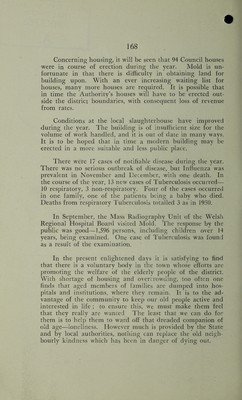
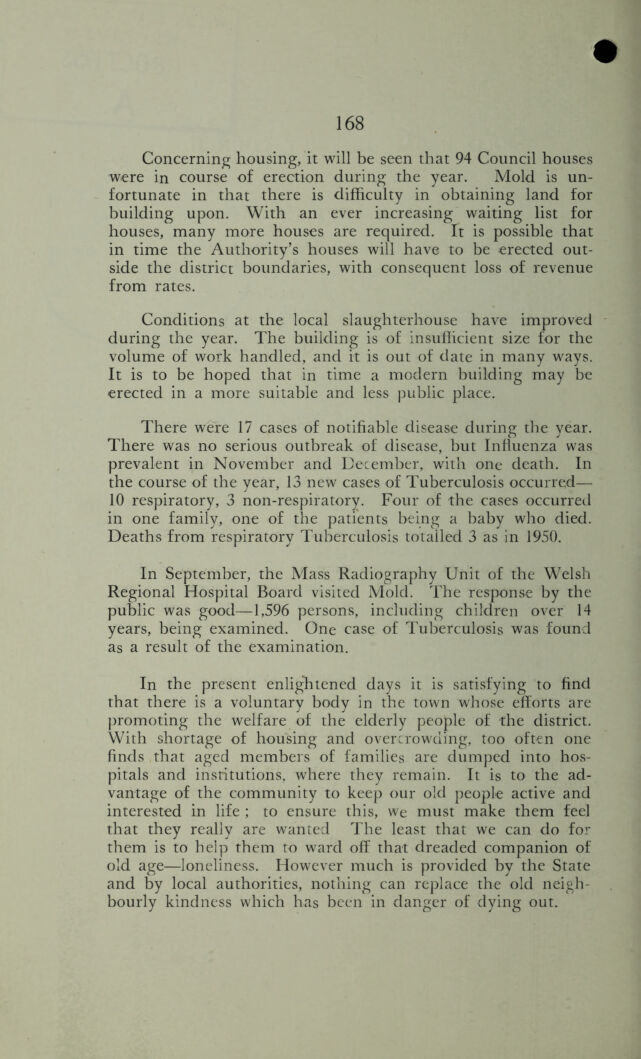
![Concerning housing, it will be seen that 94 Council houses were in course of erection during the year. Mold is un- fortunate in that there is difficulty in obtaining land for building upon. With an ever increasing waiting list for houses, many more houses are required. It is possible that in time the Authority’s houses will have to be erected out- side the district boundaries, with consequent loss of revenue from rates. Conditions at the local slaughterhouse have improved - during the year. The building is of insufficient size for the volume of work handled, and it is out of date in many ways. It is to be hoped that in time a modern building may be erected in a more suitable and less juiblic place. There were 17 cases of notifiable disease during the year. There was no serious outbreak of disease, but Influenza was prevalent in November and Uecember, with one death. In the course of the year, 13 new cases of Tuberculosis occurred— 10 respiratory, 3 non-respiratory. Four of the cases occurreil in one family, one of the patients being a baby who died. Deaths from respiratory Tuberculosis totalled 3 as in 1950. In September, the Mass Radiography Unit of the Welsh Regional Hospital Board visited Mold. The response by the public was good—1,596 persons, including children over 14 years, being examined. One case of Tuberculosis was found as a result of the examination. In the present enlightened days it is satisfying to find that there is a voluntary body in the town whose efforts are ])romoting the welfare of the elderly people of the district. With shortage of housing and overcrowding, too often one finds that aged members of families are dumped into hos- pitals and institutions, where they remain. It is to the ad- vantage of the community to keep our old people active and interested in life ; to ensure this, we must make them feel that they really are wanted The least that we can do for them is to help them to ward off that dreaded companion of old age—loneliness. However much is provided by the State and by local authorities, nothing can replace the old neigh- bourly kindness which has been in danger of dying out.](https://iiif.wellcomecollection.org/image/b29252155_0002.jp2/full/800%2C/0/default.jpg)