Some account of the last yellow fever epidemic of British Guiana / by Daniel Blair ; edited by John Davy.
- Date:
- 1850
Licence: Public Domain Mark
Credit: Some account of the last yellow fever epidemic of British Guiana / by Daniel Blair ; edited by John Davy. Source: Wellcome Collection.
Provider: This material has been provided by the Royal College of Physicians of Edinburgh. The original may be consulted at the Royal College of Physicians of Edinburgh.
101/222 (page 81)
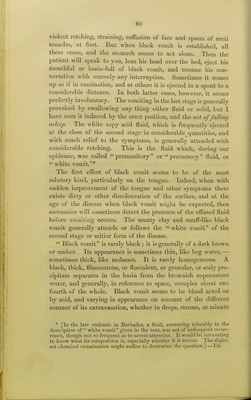
![exudation, and the different proportions of acid and serum which the extravasated blood meets with. Solution of nitrate of silver throws down a white precipitate from black vomit. Black vomit reddens litmus paper, and it effervesces with alkaline car- bonates. In one experiment si. of carbonate of potash neutral- ized J xii. of black vomit. If liquor potassae be added to black vomit beyond what is required for neutralizing the acid, the granular or flocculent sediment becomes dissolved, and the vomit becomes homogeneous and perfectly clear, like light-coloured port wine. In one case, of black vomit, mixed with an equal quantity of water, required 3 ii. of liquor potassae to render it transparent and homogeneous. Although black vomit itself is odourless,—when distilled, the clear water that comes over has a peculiarly offensive odour. If it be inspissated, the extract, although not foetid, nor pungent, nor exceedingly dis- agreeable, produces on some persons instant retching on being smelled. Blood allowed to drop, as in epistaxis, into water acidulated with muriatic acid, forms a very tolerable specimen of some descriptions of black vomit. The altered condition of the blood, previous to extravasation into the acid fluids of the stomach, may have some modifying effect in forming the mate- rial known as black vomit, but I have seen genuine black vomit contemporaneous with florid epistaxis.* Black vomit is a symptom not essentially necessary to a genuine case of yellow fever. It manifests only one phase of the stage of passive haemorrhage, and many other haemorrhages (even lochial) may be its equivalent as well as its accompani- * [The view taken by the Author of the nature of black vomit, accords, I believe, with the most accurate experiments which have been ma<le on it. I have always found peroxide of iron in the ashes procured by incinerating the solid dark matter obtained by evaporation. Under the microscope black vomit has appeared to be very heterogeneous, exhibiting small irregular plates, not unlike epithelium plates; numerous particles, not unlike blood corpuscles altered by the action of water ; and some larger and greyish clustered particles. The black vomit, the subject of this examination, was from a sporadic case of fever, which terminated fatally, in Barbados, in November, 1845. Other specimens, tried when the disease was endemic in 1848-9, had just the same microscopic character: in every instance it was found to be acid, either by the test of litmus paper, or by effervescence on the addition of an alkaline carbonate. In Jamaica, as I have been informed by an eminent physician of that island, an oily fluid has often been observed on the surface of the black vomit in sporadic cases of yellow fever, there common, and that in instances where no oleaginous medicines had been administered.] — Ed. G](https://iiif.wellcomecollection.org/image/b21976077_0101.jp2/full/800%2C/0/default.jpg)