Some account of the last yellow fever epidemic of British Guiana / by Daniel Blair ; edited by John Davy.
- Date:
- 1850
Licence: Public Domain Mark
Credit: Some account of the last yellow fever epidemic of British Guiana / by Daniel Blair ; edited by John Davy. Source: Wellcome Collection.
Provider: This material has been provided by the Royal College of Physicians of Edinburgh. The original may be consulted at the Royal College of Physicians of Edinburgh.
98/222 page 78
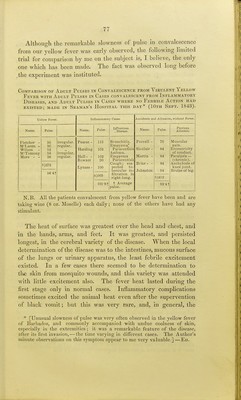
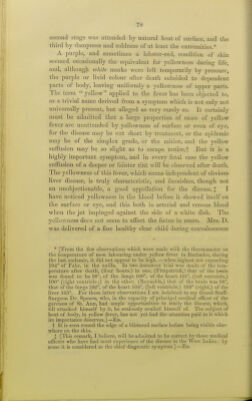
![second stage was attended by natural heat of surface, and the third by dampness and coldness of at least the extremities.* A purple, and sometimes a lobster-red, condition of skin seemed occasionally the equivalent for yellowness during life, and, although white marks were left temporarily by pressure, the purple or livid colour after death subsided to dependent parts of body, leaving uniformly a yellowness of upper parts. The term yellow applied to the fever has been objected to, as a trivial name derived from a symptom which is not only not universally present, but alleged as very rarely so. It certainly must be admitted that a large proportion of cases of yellow fever are unattended by yellowness of surface or even of eye, for the disease may be cut short by treatment, or the epidemic may be of the simplex grade, or the mitior, and the yellow suffusion may be so slight as to escape notice.f But it is a highly important symptom, and in every fatal case the yellow suffusion of a deeper or fainter tint will be observed after death. The yellowness of this fever, which seems independent of obvious liver disease, is truly characteristic, and furnishes, though not an unobjectionable, a good appellation for the disease. % I have noticed yellowness in the blood before it showed itself on the surface or eye, and this both in arterial and venous blood when the jet impinged against the side of a white dish. The yellowness docs not seem to affect the foetus in utero. Mrs. D. was delivered of a fine healthy clear child during convalescence * [From the few observations which were made with the thermometer on the temperature of men labouring under yellow fever in Barbados, during the last endemic, it did not appear to be high, — when highest not exceeding 104° of Fahr. in the axilla. In two instances trial was made of the tem- perature after death, (four hours,) in one, (Fitzpatrick,) that of the brain was found to be 98°, of the lungs 100°, of the heart 101°, (left ventricle,) 100° (right ventricle;) in the other, (Reynolds,) that of the brain was 98°, that of the lungs 102°, of the heart 104°, (left ventricle,) 103° (right,) of the liver 103°. For these latter observations I am indebted to my friend Staff- Surgeon Dr. Spence, who, in the capacity of principal medical oflicer of the garrison of St. Ann, had ample opportunities to study the disease, which, till attacked himself by it, he zealously availed himself of. The subject of heat of body, in yellow fever, has not yet had the attention paid to it which its importance deserves.]—Ed. f It is seen round the edge of a blistered surface before being visible else- where on the skin. % [This remark, I believe, will be admitted to be correct by those medical ofliccrs who have had most experience of the disease in the West Indies: by some it is considered as the chief diagnostic symptom.] —Ed.](https://iiif.wellcomecollection.org/image/b21976077_0098.jp2/full/800%2C/0/default.jpg)
 No text description is available for this image
 No text description is available for this image
 No text description is available for this image