Annual report of the trustees of the Museum of Comparative Zoölogy, at Harvard College, in Cambridge : together with the report of the director, 1865.
- Museum of Comparative Zoology
- Date:
- 1866
Licence: Public Domain Mark
Credit: Annual report of the trustees of the Museum of Comparative Zoölogy, at Harvard College, in Cambridge : together with the report of the director, 1865. Source: Wellcome Collection.
Provider: This material has been provided by The Royal College of Surgeons of England. The original may be consulted at The Royal College of Surgeons of England.
11/36 page 9
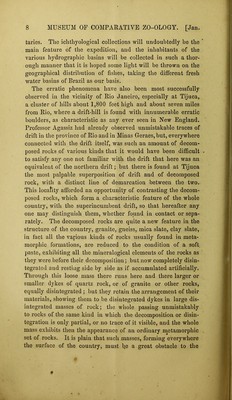
![1866.] study of the erratic phenomena, and it is not strange that those who seem familiar with the counti’y should entertain the idea that the surface rocks are everywhere decomposed and that there is no erratic formation nor drift here. But upon close examination it is easy to see that while the decomposed rocks consist of the small particles of the primitive rocks, which they represent, with their dykes and all other characteristic features, there is not a trace of larger or smaller boulders in them; while the superincumbent drift, consisting of similar parts, does not show the slightest sign of the indistinct stratification characteristic of the decomposed metamorphic rocks below it, nor any of the decomposed dykes, but is full of various kinds of boulders of different dimensions. The boulders have not yet been traced to their origin; the majority consist of a kind of greenstone, composed of nearly equal amounts of a greenish black hornblende and feldspar; this greenstone is said by mining engineers to be found in Entre Rios, on tlie Parahyba, where iron mines are worked in a rock like these boulders. Thus far the only evidence furnished of the action of glaciers is the extensive accumulation of drift, similar in its characteristics to northern drift. No trace has been found of glacial action, properly speaking, such as polished surfaces, scratches and furrows. The decomposition of the surface rocks and the extent to which it takes place in Brazil is very remarkable, and points to a new geological agency, thus far not noticed in our geological theories. It is obvious that the warm rains falling upon the heated soil must have a very powerful action in accumulat- ing the decomposition of rocks; and, as these rains have fallen for ages in succession upon hot stones, instead of wondering at the amount of decomposed rocks, we should rather wonder that there are any rocks left in their primitive condition. All the rocks being, however, encased in a lining of the decomposed part of their surface, they are thus protected by a rotten crust from further decomposition. As the expedition is almost entirely composed of young men formerly working at the Museum, the force left to carry on our operations atjiome has been greatly reduced, and consequently less has been done than in former years for the arrangement of the collection; but it is hoped that on the return of the 0](https://iiif.wellcomecollection.org/image/b22398144_0013.jp2/full/800%2C/0/default.jpg)




 No text description is available for this image
 No text description is available for this image
 No text description is available for this image