A lecture on the physiology of digestion : introductory to a course of lectures on the Institutes of Medicine and Materia Medica : delivered before the medical class of the University of the City of New York, at the session of 1844-5 / by Martyn Paine.
- Martyn Paine
- Date:
- 1844-5
Licence: Public Domain Mark
Credit: A lecture on the physiology of digestion : introductory to a course of lectures on the Institutes of Medicine and Materia Medica : delivered before the medical class of the University of the City of New York, at the session of 1844-5 / by Martyn Paine. Source: Wellcome Collection.
Provider: This material has been provided by the National Library of Medicine (U.S.), through the Medical Heritage Library. The original may be consulted at the National Library of Medicine (U.S.)
3/24
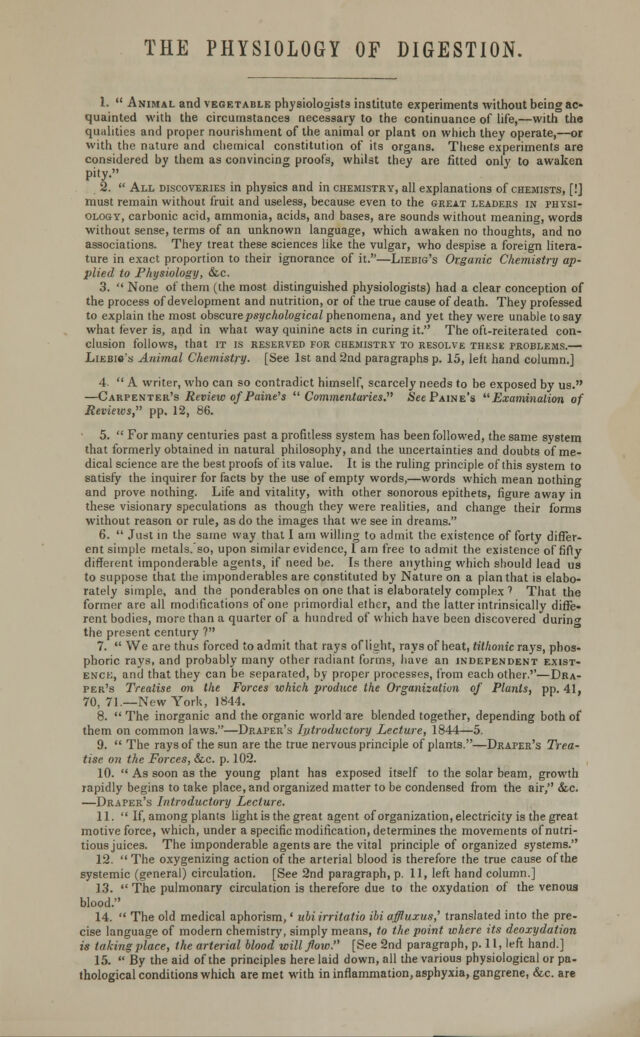
![THE PHYSIOLOGY OF DIGESTION. 1. Animal and vegetable physiologists institute experiments without being ac- quainted with the circumstances necessary to the continuance of life,—with the qualities and proper nourishment of the animal or plant on which they operate,—or with the nature and chemical constitution of its organs. These experiments are considered by them as convincing proofs, whilst they are fitted only to awaken pity. 2. All discoveries in physics and in chemistry, all explanations of chemists, [!] must remain without fruit and useless, because even to the great leaders in physi- ology, carbonic acid, ammonia, acids, and bases, are sounds without meaning, words without sense, terms of an unknown language, which awaken no thoughts, and no associations. They treat these sciences like the vulgar, who despise a foreign litera- ture in exact proportion to their ignorance of it.—Liebig's Organic Chemistry ap- plied to Physiology, &c. 3. None of them (the most distinguished physiologists) had a clear conception of the process of development and nutrition, or of the true cause of death. They professed to explain the most obscure psychological phenomena, and yet they were unable to say what fever is, and in what way quinine acts in curing it. The oft-reiterated con- clusion follows, that it is reserved for chemistry to resolve these problems.— Liebig's Animal Chemistry. [See 1st and 2nd paragraphs p. 15, left hand column.] 4- A writer, who can so contradict himself, scarcely needs to be exposed by us. —Carpenter's Review of Paine's Commentaries. SccPaine's Examination of Reviews, pp. 12, 86. 5. For many centuries past a profitless system has been followed, the same system that formerly obtained in natural philosophy, and the uncertainties and doubts of me- dical science are the best proofs of its value. It is the ruling principle of this system to satisfy the inquirer for facts by the use of empty words,—words which mean nothing and prove nothing. Life and vitality, with other sonorous epithets, figure away in these visionary speculations as though they were realities, and change their forms without reason or rule, as do the images that we see in dreams. 6. Just in the same way that I am willing to admit the existence of forty differ- ent simple metals, so, upon similar evidence, I am free to admit the existence of fifty different imponderable agents, if need be. Is there anything which should lead us to suppose that the imponderables are constituted by Nature on a pianthat is elabo- rately simple, and the ponderables on one that is elaborately complex ? That the former are all modifications of one primordial ether, and the latter intrinsically diffe- rent bodies, more than a quarter of a hundred of which have been discovered durin<* the present century ? 7. We are thus forced to admit that rays of light, rays of heat, titlionic rays, phos- phoric rays, and probably many other radiant forms, have an independent exist- ence and that they can be separated, by proper processes, from each other.''—Dra- per's Treatise on the Forces which produce the Organization of Plants, pp. 41, 70, 71.—New York, 1844. 8. The inorganic and the organic world are blended together, depending both of them on common laws.—Draper's Introductory Lecture, 1844—5. 9. The rays of the sun are the true nervous principle of plants.—Draper's Trea- tise on the Forces, &c. p. 102. 10. As soon as the young plant has exposed itself to the solar beam, growth rapidly begins to take place, and organized matter to be condensed from the air, &c. —Draper's Introductory Lecture. 11. If, among plants light is the great agent of organization, electricity is the great motive force, which, under a specific modification, determines the movements of nutri- tious juices. The imponderable agents are the vital principle of organized systems. 12. The oxygenizing action of the arterial blood is therefore the true cause of the systemic (general) circulation. [See 2nd paragraph, p. 11, left hand column.] 13. The pulmonary circulation is therefore due to the oxydation of the venous blood. 14. The old medical aphorism,' ubi irritatio ibi affluxus,' translated into the pre- cise language of modern chemistry, simply means, to the point where its deoxydation is taking place, the arterial blood will flow. [See 2nd paragraph, p. 11, left hand.] 15. By the aid of the principles here laid down, all the various physiological or pa- thological conditions which are met with in inflammation, asphyxia, gangrene, &c. are](https://iiif.wellcomecollection.org/image/b21145064_0003.jp2/full/800%2C/0/default.jpg)