A lecture on the physiology of digestion : introductory to a course of lectures on the Institutes of Medicine and Materia Medica : delivered before the medical class of the University of the City of New York, at the session of 1844-5 / by Martyn Paine.
- Martyn Paine
- Date:
- 1844-5
Licence: Public Domain Mark
Credit: A lecture on the physiology of digestion : introductory to a course of lectures on the Institutes of Medicine and Materia Medica : delivered before the medical class of the University of the City of New York, at the session of 1844-5 / by Martyn Paine. Source: Wellcome Collection.
Provider: This material has been provided by the National Library of Medicine (U.S.), through the Medical Heritage Library. The original may be consulted at the National Library of Medicine (U.S.)
4/24
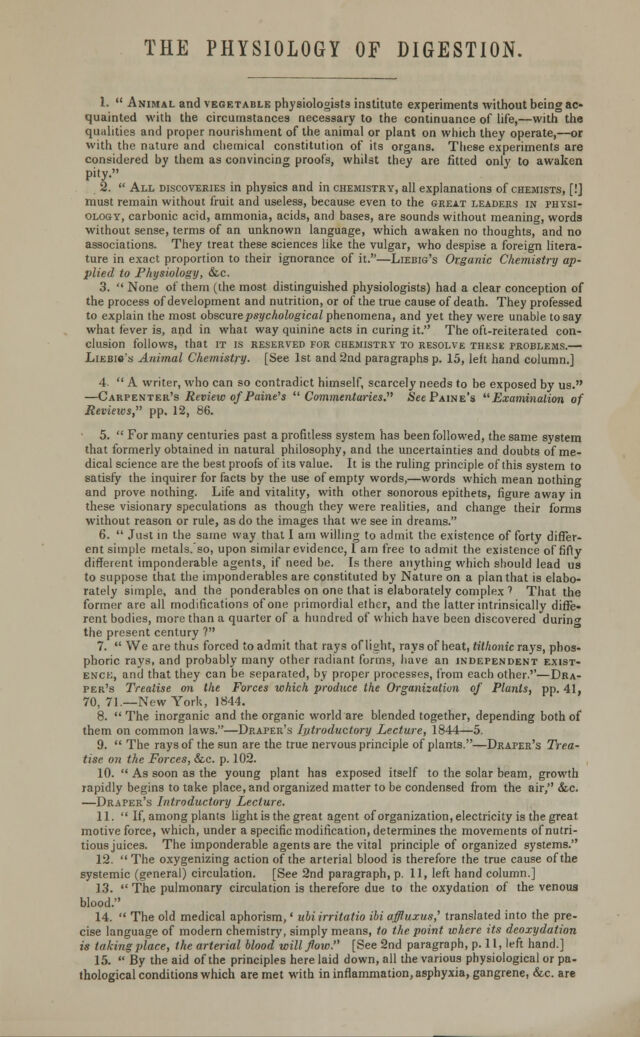
![presented as so many interesting chemical problems for solution.—[See 4th para- graph, page 15th, right hand column.] 16. It is a vulgar error that a living being possesses a principle of resistance to ex- ternal agents, while a dead one submits itself to them. Both equally change, or of the two, the living one putrifies and changes the more rapidly.—Draper's Treatise on the Forces, &c pp. 23, 36, 41, 6. [See 4th paragraph, p. 10, and 3rd p. 15, and line 5th, &c. p. 12, right column.] 17. And now I hope to see this University, as it is the first to introduce these cap- ital improvements, keep the first in the emulous race with all its sister institutions. I want to see it the great factory of Chemical discoveries and chemical doctrines in the western world.—Draper's Introductory Lecture. 18. Chemists and natural philosophers, accustomed to study the phenomena over which the physical forces preside, have carried their spirit of calculation into the the- ories of the vital laws.—Bichat's General Anatomy, vol. 2, p. 54. 19. Let a man be given up to the contemplation of one sort of knowledge, and that will become every thing. The mind will take such a tincture from a familiarity with that object, that every thing else, how remote soever, will be brought under the same view. A metaphysician will bring ploughing and gardening immediately to ab- stract notions ;—the history of nature will signify nothing to him. A chemist, on the contrary, shall reduce divinity to the maxims of his laboratory, explain morality by sal, sulphur, and mercury, and allegorize the Scripture itself, and the sacred mys- teries thereof, into the philosopher's stone-—Locke, on the Human Understanding. 20. Mr. Locke, I think, mentions an eminent musician, who believed that God cre- ated the world in six days, and rested on the seventh, because there are but seven notes in music. I, myself, knew one of that profession who thought there were only three parts in harmony, to wit: base, tenor, and treble, because there are but three persons in the Trinity.—Reid, on the Powers of the Human Mind, vol. 2 Essay 6. c. 8. 21. When education takes in error as a part of its system, there is no doubt that it will operate with abundant energy, and to an extent indefinite.—Burke. Differences of opinion on questions of great moment to mankind are apt to be strongly conveyed, and apparent error to be censured in no measured terms. This, perhaps, is often admissible, considering the obstinacy of error, and so long as it is the doctrine, and not its au- thor, which is assailed. We may revere the names of Voltaire, of Hume, and of Gibbon, yield them a proud rank in the scale of intel- lect, and gratefully acknowledge the rich legacies they have left be- hind. But, who of us would hesitate to speak of their infidelity according to its nature and tendencies ? This is even demanded by what we believe of the precepts of religion. And so of the principles of medicine, which hold as high a relation to the temporal interests of man, as do the precepts of religion to his spiritual welfare. The high- est order of intellect is often devoted to the dissemination of error, and perhaps more frequently in religion and medicine than in any other of the great interests of mankind. This must be fully and firmly met, not only by evidences of the truth, but by an exposure of its perver- sions and corruptions. In the discussion of my subject, (the controverted physiology of dio-es- tion,) I shall bring to your consideration the misapplication of chemis- try to the processes of life ; but in doing this, it will be only in the defence of truth, and not with a view of diminishing your respect for an important science. We must regard its defects abstractedly, and endeavor to eradicate such impurities as tarnish its lustre. We must still yield to it all the praise to which it is entitled by the devoted in- dustry of its cultivators, by its elevated rank amongst the sciences, and by its usefulness to man. Indeed, as a science of general usefulness,](https://iiif.wellcomecollection.org/image/b21145064_0004.jp2/full/800%2C/0/default.jpg)