A guide to the examination of the nose : with remarks on the diagnosis of diseases of the nasal cavities / by E. Cresswell Baber.
- Date:
- 1886
Licence: Public Domain Mark
Credit: A guide to the examination of the nose : with remarks on the diagnosis of diseases of the nasal cavities / by E. Cresswell Baber. Source: Wellcome Collection.
Provider: This material has been provided by the Royal College of Physicians of Edinburgh. The original may be consulted at the Royal College of Physicians of Edinburgh.
67/200 page 51
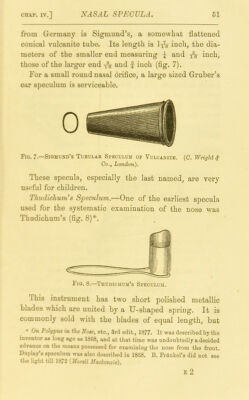
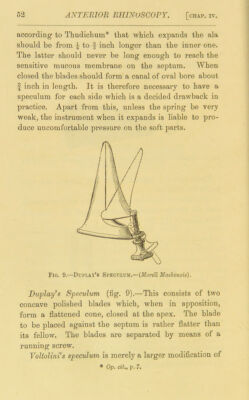
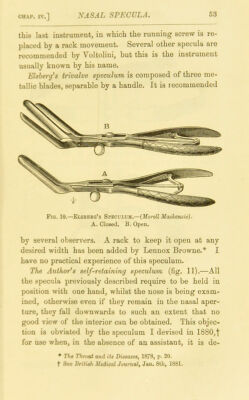
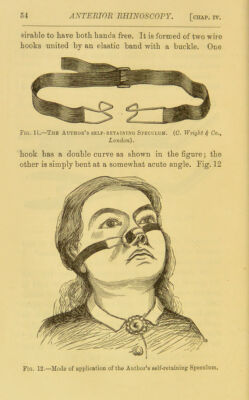
![from Germany is Sigmund's, a somewhat flattened conical vulcanite tube. Its length is ]T7ff inch, the dia- metex*s of the smaller end measuring £ and fV inch, those of the larger end x* and f inch (fig. 7). For a small x-ound nasal orifice, a large sized Gruber's ear speculum is sex’viceable. Fig. 7.—Sigmund’s Tubulak Speculum of Vulcanite. (C. Wright <$■ Co., London). These specula, especially the last named, are very useful for children. Thudiclium’s Speculum.—One of the earliest specula used for the systematic examination of the nose was Thudichum's (fig. 8)*. This instrument has two short polished metallic blades which are united by a U-shaped spring. It is commonly sold with the blades of equal length, but * On Polypus in the Nose, etc., 3rd edit., 1877. It was described by the inventor as long ago aa 1808, and at that time was undoubtedly a decided advance on the means possessed for examining tho nose from the front. Duplay’s speculum was also described in 1808. 13. Friiukol’s did not soe the light till 1S72 (Morell Mackenzie). Fig. 8.—Thudichum’s Speculum. E 2](https://iiif.wellcomecollection.org/image/b21905733_0067.jp2/full/800%2C/0/default.jpg)
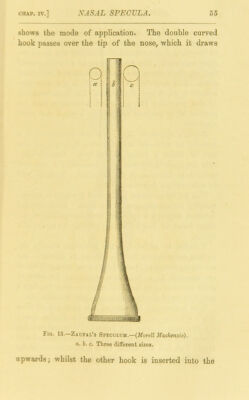
 No text description is available for this image
 No text description is available for this image
 No text description is available for this image