A treatise on chemistry. Vol. II, Metals. Part II / by H.E. Roscoe & C. Schorlemmer ...
- Henry Enfield Roscoe
- Date:
- 1880
Licence: Public Domain Mark
Credit: A treatise on chemistry. Vol. II, Metals. Part II / by H.E. Roscoe & C. Schorlemmer ... Source: Wellcome Collection.
Provider: This material has been provided by University of Bristol Library. The original may be consulted at University of Bristol Library.
32/576
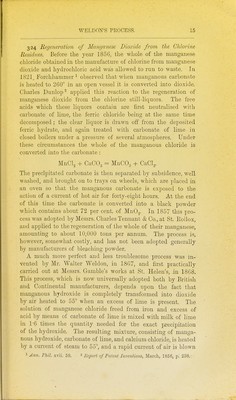
![moist air. It forms a dark-brown powder capable of soiling very strongly, and gives off its water at a temperature above 100°. It dissolves in hot nitric acid with formation of manganous nitrate and manganese dioxide : Mn202(OH)2 + 2HNO3 = Mn(N03)2 + MnOg + 2H,0. From this reaction it would appear that in constitution this body resembles lead dioxide and analogous compounds, but in other reactions it acts as a feebly basic oxide, whose salts, with a few exceptions, are very unstable. 321 Manganic Chloride, Mn^Clg, is not known in the solid state ; it can, however, be obtained in solution as a brown liquid by carefully adding the oxide or hydroxide in small quantity to cold hydrochloric acid. On heating the solution chlorine is evolved and the manganic chloride decomposed: MugClg = 2MnCl2 + Q\. Manganic Sulphate, 1^^2(804)3. Manganic oxide and hydroxide dissolve with difficulty in sulphuric acid. The red oxide, MUgO^, on the other hand, dissolves readily, yielding a purple- red-coloured solution. If the finely-divided precipitated dioxide be ti'eated with sulphuric acid, oxygen is evolved, and at a temperature of 138° a green liquid is obtained from which the sulphate is precipitated as a non-crystalline powder. In order to purify this salt it is brought on to a porous porcelain plate, when the greater part of the sulphuric acid is absorbed; the residue is then washed with pure nitric acid and the salt allowed to dry in absence of air on another porous plate, and then is heated to 150°,i but not beyond this point, as it decomposes at 160° with evolution of oxj'gen. It deliquesces on exposure to air, forming a violet solution, from which, especially when in contact with water, manganic hydroxide separates. Manganic Potassium Sulphate, or Manganese Alum, K,SO^ + Mn2(S04)3 -1- 24H2O. This is obtained when potassium sulphate is added to a solution of the foregoing salt containing an excess of sulphuric acid. On evaporation to a syrupy consistency the above salt crystallises out in violet-coloured regular octohe- drons ; it is decomposed in contact with water with separation of manganic hydroxide. Manganese. Ammonium Alum, (NK^^SO^]- Mn2(S04')3-f24H.,0. 1 Carius, Ann. Chem. Pharm. xcviii. 53.](https://iiif.wellcomecollection.org/image/b21449028_0032.jp2/full/800%2C/0/default.jpg)



 No text description is available for this image
 No text description is available for this image
 No text description is available for this image