A treatise on chemistry. Vol. II, Metals. Part II / by H.E. Roscoe & C. Schorlemmer ...
- Henry Enfield Roscoe
- Date:
- 1880
Licence: Public Domain Mark
Credit: A treatise on chemistry. Vol. II, Metals. Part II / by H.E. Roscoe & C. Schorlemmer ... Source: Wellcome Collection.
Provider: This material has been provided by University of Bristol Library. The original may be consulted at University of Bristol Library.
33/576
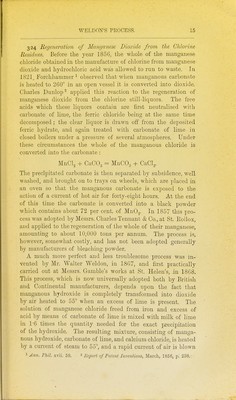
![This salt corresponds closely to the above-mentioned potassium compound, and is obtained in a similar way. Manganic Phosphates. Both manganic oxide and the dioxide dissolve in a concentrated solution of phosphoric acid, in the latter case with evolution of oxygen, with, formation of a deep violet liquid, from wbich a violet-coloured crystalline mass separates out (Gmelin). This decomposes in contact with water, and manganic hydroxide is precipitated from the solution by the alkalis. On evaporating the red solution a peach-blossom coloured powder separates, consisting of manganic metaphos- phate, Mn2(P03)e + ^'E.f)} Manganese Dioxide and the Manganites. 322 Manganese Dioxide, Manganese Peroxide, or Black Oxide of Manganese, MnO^, is the most important ore of manganese. It occurs in rhombic crystals and in crystalline and amorphous masses, being known to the mineralogist as pyrolusite. It pos- sesses a metallic lustre, an iron-black or dark steel-grey colour, and a black streak. It is opaque and rather brittle, and has a specific gravity of 4'82. The most celebrated localities for this mineral are Ilmenau in Thuringia, near Platten in Bohemia, near Mahrisch-Trubau in Moravia, on the Lahn, and in France, Spain, and iSTorth America. It occurs in the United States, abundantly at Vermont in Massachusetts, and in Eed Island Bay at San Francisco ; and also in New Brunswick, ISTova Scotia. It is like- wise found in Devonshire. Pyrolusite seldom occurs in the pure state, being generally mixed with other manganese ores such as psilomelane, (MnBa)O -f- 2Mn02, and manganite. It also always contains ferric oxide, silica, and traces of the oxides of cobalt and nickel. Pure manganese dioxide is obtained artificially by a moderate ignition of the nitrate. The residue is then boiled out witli nitric acid, washed well, and moderately heated (Berthier). If manganous carbonate be heated to 260° in presence of air, and then the residue treated with very dilute'cold hydrochloric acid, pure manganese dioxide remains behind (Forchhammer). It is obtained in the hydrated state by precipitating a manga- nese solution with an alkaline solution of an hypochlorite, or by treating manganic hydroxide with hot nitric acid.'^ The ' Hprmann, Tocjrj. Ann. Ixxiv. 303. ' Gorgen, A7in. Chim. Phys. [3], Ixvi. 155.](https://iiif.wellcomecollection.org/image/b21449028_0033.jp2/full/800%2C/0/default.jpg)



 No text description is available for this image
 No text description is available for this image
 No text description is available for this image