A treatise on chemistry. Vol. II, Metals. Part II / by H.E. Roscoe & C. Schorlemmer ...
- Henry Enfield Roscoe
- Date:
- 1880
Licence: Public Domain Mark
Credit: A treatise on chemistry. Vol. II, Metals. Part II / by H.E. Roscoe & C. Schorlemmer ... Source: Wellcome Collection.
Provider: This material has been provided by University of Bristol Library. The original may be consulted at University of Bristol Library.
48/576
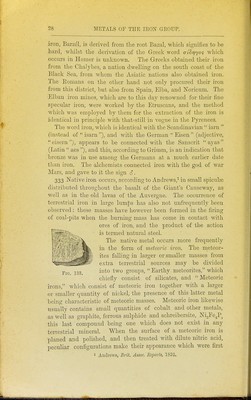
![iron, Barz^l, is derived from the root Bazal, which signifies to be hard, whilst the derivation of the Greek word aiBijyo<} which occurs in Homer is unknown. The Greeks obtained their iron from the Chalybes, a nation dwelling on the south coast of the Black Sea, from whom the Asiatic nations also obtained iron. The Eomans on the other hand not only procured their iron from this district, ])ut also from Spain, Elba, and Koricum, The J^lban iron mines, which are to this day renowned for their fine specular iron, were worked by the Etruscans, and the method which was employed by them for the extraction of the iron is identical in principle with that still in vogue in the Pyrenees. The word iron, which is identical with the Scandinavian iarn (instead of isarn ), and with the German Eisen (adjective, eisern ), appears to be connected with the Sanscrit ayas (Latin aes ), and this, according to Grimm, is an indication that bronze was in use among the Germans at a much earlier date than iron. The E^lchemists connected iron with the god of war Mars, and gave to it the sign 6. 333 Native iron occurs, according to Andrews,^ in small spicules distributed throughout the basalt of the Giant's Causeway, as well as in the old lavas of the Auvergne. The occurrence of terrestrial iron in large lum{)s has also not unfrequently been observed: these masses have however been formed in the firing of coal-pits when the burning mass has come in contact with ores of iron, and the product of the action is termed natural steel. The native metal occurs more frequently in the form of meteoric iron. The meteor- ites falling in larger or smaller masses from extra terrestrial sources may be divided into two groups, Earthy meteorites, which chiefly consist of silicates, and Meteoric irons, which consist of meteoric iron together with a larger or smaller quantity of nickel, the presence of this latter metal being characteristic of meteoric masses. Meteoric iron likewise usually contains small quantities of cobalt and other metals, as well as graphite, ferrous sulphide and sclireibersite, MoFe^P, this last compound being one which does not exist in any terrestrial mineral. When the surface of a meteoric iron is planed and polished, and then treated with dilute nitric acid, peculiar configurations make their appearance which were first 1 Andrews, Brit, Assoc. Reports, 1852.](https://iiif.wellcomecollection.org/image/b21449028_0048.jp2/full/800%2C/0/default.jpg)

 No text description is available for this image
 No text description is available for this image
 No text description is available for this image