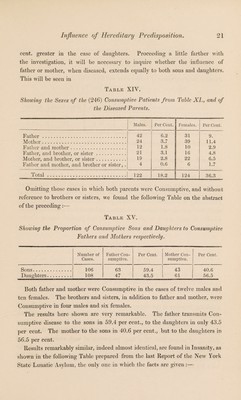
The first [-second] medical report of the Hospital for Consumption and Diseases of the Chest, presented to the Committee of Management, by the physicians of the institution.
- Royal Brompton Hospital
- Date:
- 1849-1863
Licence: Public Domain Mark
Credit: The first [-second] medical report of the Hospital for Consumption and Diseases of the Chest, presented to the Committee of Management, by the physicians of the institution. Source: Wellcome Collection.
27/48 page 23
![])ecting the presence of tubercular deposit, yet the physical signs are either absent, or so indistinct, that the most experienced observers can scarcely detect them. Under these circumstances, additional means of diagnosis are obviously desirable; and the Medical Officers felt it their duty to avail themselves of the opportunity afforded by the large number of Phthisical Patients under their charge, to test the value of all modern means suggested for detecting the disease in its early stage. a—Spirometer Observations.—One of these means is an instrument named the Spirometer, intended to ascertain the caj)acity of the lungs for air, and which may be expected to give indication of the extent to which they are ob« structed by tubercular or other deposits. Dr. Hutchinson, who has published a series of valuable observations calling the attentioii of the profession to the subject, kindly offered us his assistance, and during several months attended at the Hospital for the purpose of testing the instrument. A large pro¬ portion of the 415 cases recorded in the Tables which have reference to this subject, were examined under his immediate superintendence; and it is satisfactory to find the results of the examination made by him and others so nearly corresponding, that all are blended in the following Tables. In Tables XVII. and XVHI. a few characteristic cases are given by way of example, in order to exhibit the amount of deviation from the healthy standard in the first and second stages of Consumption. Dr. Hutchinson has shown that, in a state of health, the vital capacity* has a relation to the height of the individual, increasing in the proportion of eight cubic inches of air for every inch of stature from five to six feet. Cases 3 and 13, in Table XVII., are examples of vital capacity only 14 and 16 inches below the presumed healthy standard. It will be observed that these Patients were above the ordinary height. The calculations, however, which have been published do not apply to persons above six feet,—observations on men above that height not being sufficiently numerous to determine the healthy standard of their vital capacity. But there are grounds for suspecting that the ratio of increase above six feet exceeds 8 inches for every inch of height. For instance, a man, examined by Dr. Hutchinson, whose height was 6 feet 11^ inches, had a vital capacity of 434 cubic inches—being in the ratio of more than 14 cubic inches of air to everv inch of stature above six feet: and * This term is applied to the utmost quantity of air which a person can expire after a deep inspiration.](https://iiif.wellcomecollection.org/image/b30382907_0027.jp2/full/800%2C/0/default.jpg)