Volume 2
Dr. Underwood's treatise on the diseases of children : with directions for the management of infants / [Michael Underwood].
- Michael Underwood
- Date:
- 1846
Licence: Public Domain Mark
Credit: Dr. Underwood's treatise on the diseases of children : with directions for the management of infants / [Michael Underwood]. Source: Wellcome Collection.
18/616 (page 2)
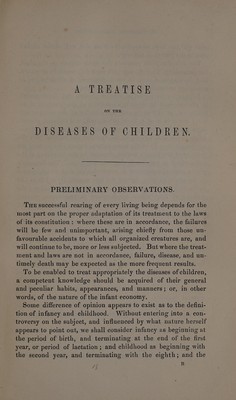
![term girl, or boy, as applicable from the end of the eig hth year to the period of puberty. The infant at birth possesses the same organs as the adult, but presenting for the most part such differences in structure, and development, and in some measure, of situation, as to constitute essential, or peculiar characters. Infancy, as the period of organic growth and development, is characterised by remarkable activity of the functions of as- similation, as well as by extreme mobility of the sentient sys- tem; the skin is of a florid colour, soft, and delicate, exceed- ingly sensible to external impressions, indicating the predomi- nance in size and activity of the vascular and nervous over the other systems. From the same natural causes also proceed the velocity of the blood’s motion, denoted by the frequency of the pulse which is peculiar to the infantile state. The frequency of the arterial pulsations is nearly double that which obtains in the adult, varying, during the first month, from 120 to 130 beats in a minute—more frequently the former number; the number of respirations are frequent in proportion, varying from 30 to 40, the inspirations and expirations being equal. The capillary circulation is extremely active, the processes of interstitial growth most vigorous, the secretions are abnndant, and the excretions frequent; which phenomena depend not merely on the abundance of blood, but on the preponderance of the arterial over the venous vessels. The infant, from being pre-eminently endowed with nervous power, is extremely apt to be affected with uneasiness or pain by the slightest external causes ; hence few or none of its diseases are unaccompanied by nervous excitement. When any re-action takes place in the system it is most powerful and sudden, according with the general mobility. The senses of sight, hearing, smell, and taste, all participate in the general susceptibility of impression, and care is requisite to prevent the inordinate application of the stimuli appropriate to each. The intense activity of the vascular and nervous systems in infancy might naturally be supposed to give rise to sudden vicissitudes in the state of the vital powers; and such, accord- ingly, we find to be the fact; for an infant will frequently re- ~ 9]](https://iiif.wellcomecollection.org/image/b29314847_0002_0018.jp2/full/800%2C/0/default.jpg)