Mexican and Central American antiquities, calendar systems, and history : twenty-four papers / by Eduard Seler [and others] ; translated from the German under the supervision of Charles P. Bowditch.
- Eduard Seler
- Date:
- 1904
Licence: In copyright
Credit: Mexican and Central American antiquities, calendar systems, and history : twenty-four papers / by Eduard Seler [and others] ; translated from the German under the supervision of Charles P. Bowditch. Source: Wellcome Collection.
732/838 (page 598)
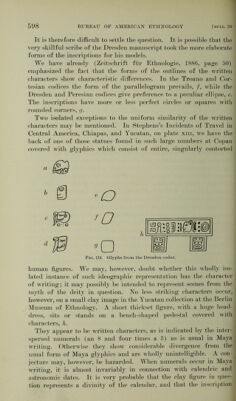
![It is therefore difficult to settle the question. It is possible that the very skillful scribe of the Dresden manuscript took the more elaborate forms of the inscriptions for his models. We have already (Zeitschrift für Ethnologie, 1886, page 50) emphasized the fact that the forms of the outlines of the written characters show characteristic differences. In the Troano and Cor- tesian codices the form of the parallelogram prevails, /, while the Dresden and Peresian codices give preference to a peculiar ellipse, e. The inscriptions have more or less perfect circles or squares with rounded corners, g. Two isolated exceptions to the uniform similarity of the written characters may be mentioned. In Stephens’s Incidents of Travel in Central America, Chiapas, and Yucatan, on plate xm, we have the back of one of those statues found in such large numbers at Copan covered with glyphics which consist of entire, singularly contorted a b c j© *o Fig. 114. Glyphs ]) - UllilfÄ:® £13 • • • Cs) 9 • • (s> the Dresden codex. human figures. We may, however, doubt whether this wholly iso- lated instance of such ideographic representation has the character of writing; it may possibly be intended to represent scenes from the myth of the deity in question. No less striking characters occur, however, on a small clay image in the Yucatan collection at the Berlin Museum of Ethnology. A short thickset figure, with a huge head- dress, sits or stands on a bench-shaped pedestal covered with characters, h. They appear to be written characters, as is indicated by the inter- spersed numerals (an 8 and four times a 3) as is usual in Maya writing. Otherwise they show considerable divergence from the usual form of Maya glyphics and are wholly unintelligible. A con- jecture may, however, be hazarded. When numerals occur in Maya writing, it is almost invariably in connection with calendric and astronomic dates. It is very probable that the clay figure in ques- tion represents a divinity of the calendar, and that the inscription](https://iiif.wellcomecollection.org/image/b24881788_0732.jp2/full/800%2C/0/default.jpg)