Handbook of materia medica, pharmacy, and therapeutics : including the physiological action of drugs, the special therapeutics of disease, official and practical pharmacy, and minute directions for prescription writing / by Sam'l O.L. Potter.
- Samuel Otway Lewis Potter
- Date:
- 1897
Licence: Public Domain Mark
Credit: Handbook of materia medica, pharmacy, and therapeutics : including the physiological action of drugs, the special therapeutics of disease, official and practical pharmacy, and minute directions for prescription writing / by Sam'l O.L. Potter. Source: Wellcome Collection.
Provider: This material has been provided by Royal College of Physicians, London. The original may be consulted at Royal College of Physicians, London.
40/944 page 34
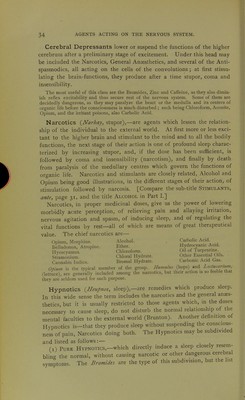
![Cerebral Depressants lower or suspend the functions of the higher cerebrum after a preliminary stage of excitement. Under this head may be included the Narcotics, General Anaesthetics, and several of the Anti- spasmodics, all acting on the cells of the convolutions; at first stimu- lating the brain-functions, they produce after a time stupor, coma and insensibility. The most useful of this class are the Bromides, Zinc and Caffeine, as they also dimin- ish reflex excitability and thus secure rest of the nervous system. Some of them are decidedly dangerous, as they may paralyze the heart or the medulla and its centres of organic life before the consciousness is much disturbed ; such being Chloroform, Aconite, Opium, and the irritant poisons, also Carbolic Acid. Narcotics {Narkay, stupor),—are agents which lessen the relation- ship of the individual to the external world. At first more or less exci- tant to the higher brain and stimulant to the mind and to all the bodily functions, the next stage of their action is one of profound sleep charac- terized by increasing stupor, and, if the dose has been sufficient, is followed by coma and insensibility (narcotism), and finally by death from paralysis of the medullary centres which govern the functions of organic life. Narcotics and stimulants are closely related. Alcohol and Opium being good illustrations, in the different stages of their action, of stimulation followed by narcosis. [Compare the sub-title Stimulants, ante, page 31, and the title Alcohol in Part I.] Narcotics, in proper medicinal doses, give us the power of lowering morbidly acute perception, of relieving pain and allaying irritation, nervous agitation and spasm, of inducing sleep, and of regulating the vital functions by rest—all of which are means of great therapeutical value. The chief narcotics are— Opium, Morphine. Belladonna, Atropine. Hyoscyamus. Stramonium. Cannabis Indica. Alcohol. Ether. Chloroform. Chloral Hydrate. Bromal Hydrate. Carbolic Acid. Hydrocyanic Acid. Oil of Turpentine. Other Essential Oils Carbonic Acid Gas. Ot)iu7n is the typical member of the group. Htimulus (hops) and Lactucarnim, (lettuce), are generally included among the narcotics, but their action is so feeble that they are seldom used for such purpose. Hypnotics {^Heupnos, sleep),—are remedies which produce sleep. In this wide sense the term includes the narcotics and the general anaes- thetics, but it is usually restricted to those agents which, in the doses necessary to cause sleep, do not disturb the normal relationship of the mental faculties to the external world (Brunton). Another definition of Hypnotics is—that they produce sleep without suspending the conscious- ness of pain. Narcotics doing both. The Hypnotics may be subdivided and listed as follows : — (1) Pure Hypnotics,—which directly induce a sleep closely resem- blinK the normal, w.thout causing narcotic or other dangerous cerebral symptoms. The Bromides are the type of this subdivision, but the list](https://iiif.wellcomecollection.org/image/b24907303_0040.jp2/full/800%2C/0/default.jpg)