Handbook of materia medica, pharmacy, and therapeutics : including the physiological action of drugs, the special therapeutics of disease, official and practical pharmacy, and minute directions for prescription writing / by Sam'l O.L. Potter.
- Samuel Otway Lewis Potter
- Date:
- 1897
Licence: Public Domain Mark
Credit: Handbook of materia medica, pharmacy, and therapeutics : including the physiological action of drugs, the special therapeutics of disease, official and practical pharmacy, and minute directions for prescription writing / by Sam'l O.L. Potter. Source: Wellcome Collection.
Provider: This material has been provided by Royal College of Physicians, London. The original may be consulted at Royal College of Physicians, London.
51/944 page 45
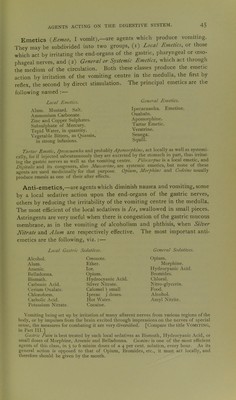
![Emetics {Eemeo, I vomit),—are agents which produce vomiting. They may be subdivided into two groups, (i) Local Emeitcs, or those which act by irritating the end-organs of the gastric, pharyngeal or ceso- phageal nerves, and (2) General or Systemic Emetics, which act through the medium of the circulation. Both these classes produce the emetic action by irritation of the vomiting centre in the medulla, the first by reflex, the second by direct stimulation. The principal emetics are the following named : — Local Emetics. Alum. Mustard. Salt. Ammonium Carbonate. Zinc and Copper Sulphates. Subsulphate of Mercup-. Tepid Water, in quantity. Vegetable Bitters, as Quassia, in strong infusions. General Emetics. Ipecacuanha. Emetine. Ouabain. Apomorphine. Tartar Emetic. Veratrine. Senega. Squill. Tartar Emetic, Ipecacuanha and probably Apomorphine, act locally as well as systemi- cally, for if injected subcutaneously they are excreted by the stomach in part, thus irritat- ing the gastric nerves as well as the vomiting centre. Eilocai'ptis is a local emetic, and Digitalis and its congeners, also J\luscartne, are systemic emetics, but none of these agents are used medicinally for that purpose. Opium, Morphine and Codeine usually produce emesis as one of their after effects. Anti-emetics,—are agents which diminish nausea and vomiting, some by a local sedative action upon the end-organs of the gastric nerves, others by reducing the irritability of the vomiting centre in the medulla. The most efficient of the local sedatives is Ice, swallowed in small pieces. Astringents are very useful when there is congestion of the gastric mucous membrane, as in the vomiting of alcoholism and phthisis, when Silver Nitrate and Alum are respectively effective. The most important anti- emetics are the following, viz. : — Local Gastric Sedatives. Alcohol. Alum. Arsenic. Belladonna. Bismuth. Carbonic Acid. Cerium Oxalate. Chloroform. Carbolic Acid. Potassium Nitrate. Creosote. Ether. Ice. Opium. Hydrocyanic Acid. Silver Nitrate. Calomel small Ipecac j doses. Hot Water. Cocaine. General Sedatives. Opium. Morphine. Hydrocyanic Acid. Bromides. Chloral. Nitro-glycerin. Food. Alcohol. Amyl Nitrite. Vomiting being set up by irritation of many afferent nerves from various regions of the body, or by impulses from the brain excited through impressions on the nerves of special sense, the measures for combating it are very diversified. [Compare the title Vomiting, in Part HI.] Gastric Fain is best treated by such local sedatives as Bismuth, Hydrocyanic Acid, or small doses of Morphine, Arsenic and Belladonna. Cocaine is one of the most efficient agents of this class, in 5 to 6 minim doses of a 4 per cent, solution, every hour. As its general action is opposed to that of Opium, Bromides, etc., it must act locally, and therefore should be given by the mouth.](https://iiif.wellcomecollection.org/image/b24907303_0051.jp2/full/800%2C/0/default.jpg)