Handbook of materia medica, pharmacy, and therapeutics : including the physiological action of drugs, the special therapeutics of disease, official and practical pharmacy, and minute directions for prescription writing / by Sam'l O.L. Potter.
- Samuel Otway Lewis Potter
- Date:
- 1897
Licence: Public Domain Mark
Credit: Handbook of materia medica, pharmacy, and therapeutics : including the physiological action of drugs, the special therapeutics of disease, official and practical pharmacy, and minute directions for prescription writing / by Sam'l O.L. Potter. Source: Wellcome Collection.
Provider: This material has been provided by Royal College of Physicians, London. The original may be consulted at Royal College of Physicians, London.
55/944 page 49
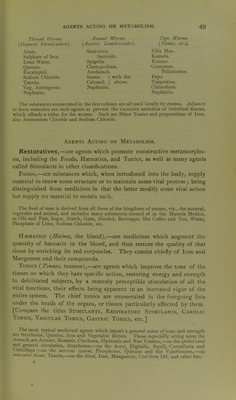
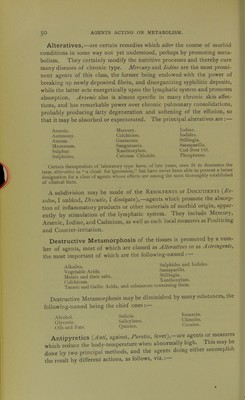
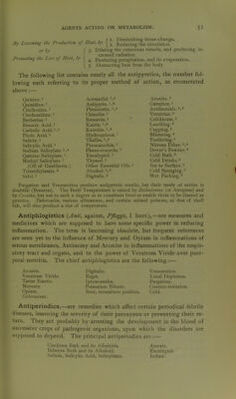
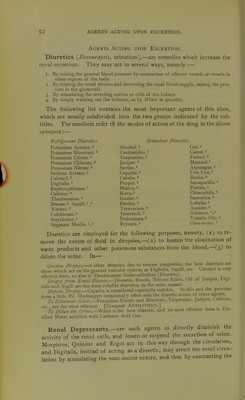
![Thread ITorms {^Oxyuris Vermicular is). Alum. Sulphate of Iron. Lime Water. Quassia. Eucalyptol. Sodium Chloride. Tannin. Veg. Astringents. Naphtalin. Round Worms scans Lumbricoides). Santonica. Santonin. Spigelia. Chenopodium. Azedarach. Senna. 1 with the Calomel. / above. Naphtalin. Tape Worms (Tcmice, etc.\. Filix Mas. Kamala. Kousso. Cranatum. Pelletierine. Pepo. Turpentine. Chloroform. Naphtalin. The substances enumerated in the first column are all used locally by enema. Adjuncts to these remedies are such agents as prevent the excessive secretion of intestinal mucus, which affords a nidus for the worms. Such are Bitter Tonics and preparations of Iron, also Ammonium Chloride and Sodium Chloride. Agents Acting on Metabolism. Restoratives,—are agents which promote constructive metamorpho- sis, including the Foods, Haematics, and Tonics, as well as many agents called Stimulants in other classifications. Foods,—are substances which, when introduced into the body, supply material to renew some structure or to maintain some vital process ; being distinguished from medicines in that the latter modify some vital action but supply no material to sustain such. The food of man is derived from all three of the kingdoms of nature, viz., the mineral, vegetable and animal, and includes many substances treated of in the Materia Medica, as Oils and Fats, Sugar, Starch, Gum, Alcohol, Beverages like Coffee and Tea, Water, Phosphate of Lime, Sodium Chloride, etc. Ha:matics (^Haima, the blood),—are medicines which augment the quantity of haematin in the blood, and thus restore the quality of that tissue by enriching its red corpuscles. They consist chiefly of Iron and Manganese and their compounds. Tonics (Tonnos, tension),—are agents which improve the tone of the tissues on which they have specific action, restoring energy and strength to debilitated subjects, by a scarcely perceptible stimulation of all the vital functions, their effects being apparent in an increased vigor of the entire system. The chief tonics are enumerated in the foregoing lists under the heads of the organs, or tissues particularly affected by them. [Compare the titles Stimulants, Respiratory Stimulants, Cardiac Ionics, Vascular Tonics, Gastric Tonics, etc.] The most typical medicinal agents which impart a general sense of tone and strength are Strychnine, Quinine, Iron and Vegetable Bitters. Those especially acting upon the stomach, are Arsenic, Bismuth, Cinchona, Hydrastis and Nux Vomica,—on the spinal cord ^d general circulation. Strychnine,—on the heart. Digitalis, Squill, Convallaria and Cimicifuga- on the nervous system. Phosphorus, Quinine and the Valerianates,—on muscular tissue, lannin,—on the blood. Iron, Manganese, Cod-liver Oil, and other fats. 4](https://iiif.wellcomecollection.org/image/b24907303_0055.jp2/full/800%2C/0/default.jpg)