Handbook of materia medica, pharmacy, and therapeutics : including the physiological action of drugs, the special therapeutics of disease, official and practical pharmacy, and minute directions for prescription writing / by Sam'l O.L. Potter.
- Samuel Otway Lewis Potter
- Date:
- 1897
Licence: Public Domain Mark
Credit: Handbook of materia medica, pharmacy, and therapeutics : including the physiological action of drugs, the special therapeutics of disease, official and practical pharmacy, and minute directions for prescription writing / by Sam'l O.L. Potter. Source: Wellcome Collection.
Provider: This material has been provided by Royal College of Physicians, London. The original may be consulted at Royal College of Physicians, London.
58/944 page 52
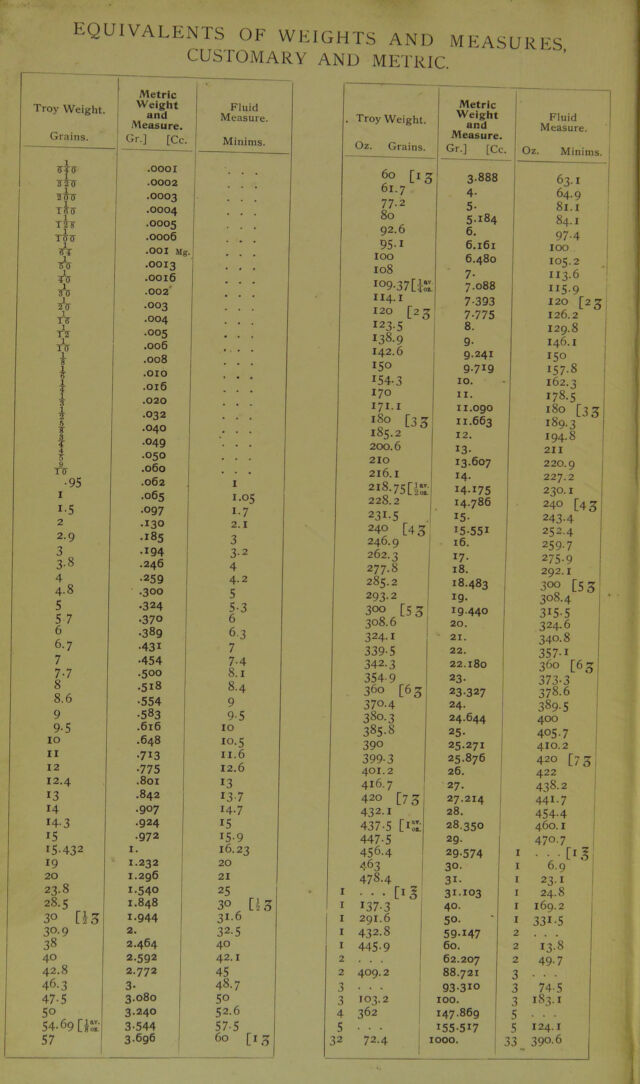
![Agents Acting upon Excretion. Diuretics (^Deeouraysis, urination),—are remedies which increase the renal secretion. They may act in several ways, namely ; — 1. By raising the general blood-pressure by contraction of efferent vessels or vessels in other regions of the body. 2. By dilating the renal arteries and increasing the renal blood-supply, raising the pres- sure in the glomeruli. 3. By stimulating the secreting nerves or cells of the kidney. 4. By simply washing out the kidneys, as by Water in quantity. The following list contains the most important agents of this class, which are usually subdivided into the two groups indicated by the sub- titles. The numbers refer t6 the modes of action of the drug in the above synopsis:— Refrigerant Diuretics. Stimulant Diuretics. Potassium Acetate.^ Alcohol. ® Gin. ® Potassium Bitartrate. ® Cantharides. ® Carrot.® Potassium Citrate.® Turpentine. ® P'ennel. ® Potassium Chlorate. ® Juniper. ® Mustard.® Potassium Nitrate.® Savine. ® Asparagus. ® Sodium Acetate. ® Copaiba. ® Uva Ursi.® Calomel. ^ Cubebs. ® Buchu. ® Digitalis. ^ Pepper. ® Sarsaparilla. ® Erythrophloeum. ^ Matico. ® Pareira. ® Caffeine. ® Kava.® Chimaphila.® Theobromine. ® Guaiac. ® Santonica. ® Broom.® Squill.^,® Parsley.® Lobelia. ® Nitrites. ® Taraxacum. ® Aconite. ® Colchicum. ® Jaborandi. ® Tobacco. ^.® Strychnine.^ Dulcamara.® Volatile Oils. ® Stigmata Maidis. Bryonia.® Oleo-resins. ® Diuretics are employed for the following purposes, namely, (i) to re- move the excess of fluid in dropsies,—(2) to hasten the elimination of waste products and other poisonous substances from the blood,—(3) to dilute the urine. In— Cardiac Dropsy,—or other dropsies due to venous congestion, the best diuretics are those which act on the general vascular system, as Digitalis, Squill, etc. Calomel is very efficient here, so also is Theobromine Sodio-salicylate (Diuretin). r t • t^- • Dropsy frovi Renal Diuretin, Broom, Nitrous Ether, Oil of Juniper, Digi- talis and Squill are the most reliable diuretics, in the order named. . ^ , Hepatic Dropsy,—Copaiba is considered especially suitable. In this and the previous form a little Pil. Hydrargyri occasionally often aids the diuretic action of other agents. To Eliminate Solids,—Potassium Nitrate and Bitartrate, Turpentine, Juniper, Catteine, etc., are the most efficient. [Compare Antilithics.] To Dilute the Urine,—Water is the best diuretic, and its most efficient tilled Water acidified with Carbonic Acid Gas. fonn is Dis- Renal Depressants,—are such agents as directly diminish the activity of the renal cells, and lessen or suspend the secretion of urine. Morphine, Quinine and Ergot act in this way through the circulation, and Digitalis, instead of acting as a diuretic, may arrest the renal circu- lation by stimulating the vaso-motor centre, and thus by contracting the](https://iiif.wellcomecollection.org/image/b24907303_0058.jp2/full/800%2C/0/default.jpg)