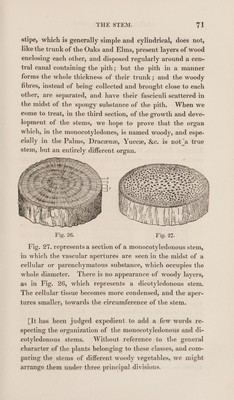
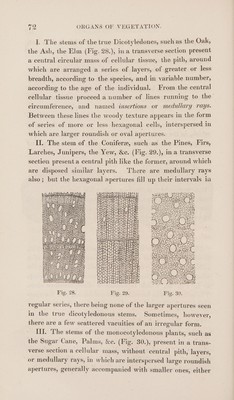
Elements of botany and vegetable physiology, including the characters of the natural families of plants, with illustrative figures / By A. Richard, M.D. Translated from the fourth edited by W. Macgillivray, A.M.
- Achille Richard
- Date:
- 1831
Licence: Public Domain Mark
Credit: Elements of botany and vegetable physiology, including the characters of the natural families of plants, with illustrative figures / By A. Richard, M.D. Translated from the fourth edited by W. Macgillivray, A.M. Source: Wellcome Collection.
105/602 page 73
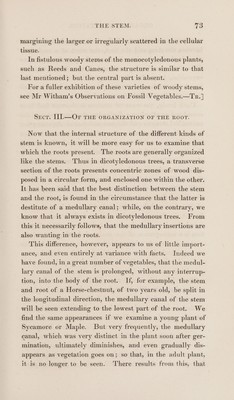
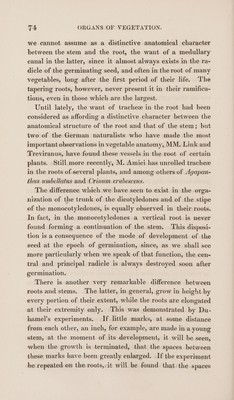
![margining the larger or irregularly scattered in the cellular tissue. In fistulous woody stems of the monocotyledonous plants, such as Reeds and Canes, the structure is similar to that last mentioned; but the central part is absent. For a fuller exhibition of these varieties of woody stems, see Mr Witham’s Observations on Fossil Vegetables.—Tr.] Sect. II.—Or THE ORGANIZATION OF THE ROOT. Now that the internal structure of the different kinds of stem is known, it will be more easy for us to examine that which the roots present. The roots are generally organized like the stems. Thus in dicotyledonous trees, a transverse section of the roots presents concentric zones of wood dis- posed in a circular form, and enclosed one within the other. It has been said that the best distinction between the stem and the root, is found in the circumstance that the latter is destitute of a medullary canal; while, on the contrary, we know that it always exists in dicotyledonous trees. From this it necessarily follows, that the medullary insertions are also wanting in the roots. This difference, however, appears to us of little import- ance, and even entirely at variance with facts. Indeed we have found, in a great number of vegetables, that the medul- lary canal of the stem 1s prolonged, without any interrup- tion, into the body of the root. If, for example, the stem and root of a Horse-chestnut, of two years old, be split in the longitudinal direction, the medullary canal of the stem will be seen extending to the lowest part of the root. We find the same appearances if we examine a young plant of Sycamore or Maple. But very frequently, the medullary canal, which was very distinct in the plant soon after ger- mination, ultimately diminishes, and even gradually dis- appears as vegetation goes on; so that, in the adult plant, it is no longer to be seen. ‘There results from this, that](https://iiif.wellcomecollection.org/image/b33093672_0105.jp2/full/800%2C/0/default.jpg)