Twelfth annual report of the managers of the State Lunatic Asylum : made to the Legislature January, 1854 / New York State Lunatic Asylum at Utica.
- New York (State). State Lunatic Asylum
- Date:
- 1854 [ie 1855]
Licence: Public Domain Mark
Credit: Twelfth annual report of the managers of the State Lunatic Asylum : made to the Legislature January, 1854 / New York State Lunatic Asylum at Utica. Source: Wellcome Collection.
29/44 (page 27)
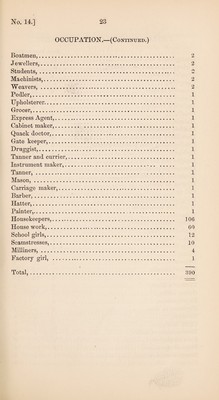
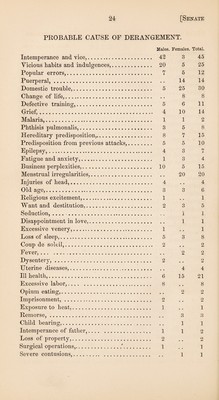
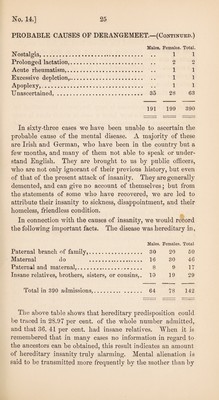
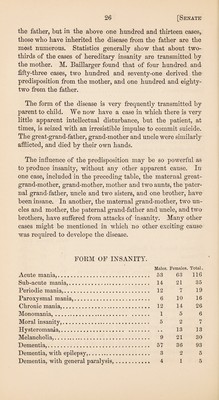
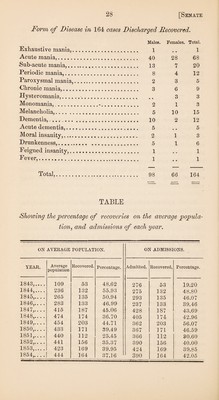
![FORM OF INSANITY—(Continued.) Mania, with epilepsy,. Males. _ 4 Females. 1 Total. 5 Mania, with general paralysis,. . 1 • 1 Drunkenness,. . 6 2 8 Feigned insanitv,.. . 2 • 2 Not insane,. 1 3 Total,..... 199 390 Thirty-four patients—eleven males and twenty-three fe¬ males—have been admitted during the year, with strong sui¬ cidal propensities. In several of these cases the ancestors had committed suicide—in two of them for three generations. In one male it was impulsive: he was also homicidal, and left home at his own request, because he felt the inclination to de¬ stroy his children—whom he loved tenderly—was gradually strengthening, while his power of resistance was growing weaker. All the epileptics admitted, and the cases of general paralysis,, had either epileptic or intemperate ancestors. It will be observed from the above table that we have received thirteen who were not insane. One was a case of typhoid fe¬ ver, one of chorea, and one a case of phthisis pulmonalis. Eight were drunkards, and two in whom insanity was feigned, in order to escape punishment in State Prison. Several, also, placed under the head of sub-acute mania, were simply cases in which there was mental prostration with tranquil delirium, the result of grave organic diseases. It is well known that when the brain and heart are seriously involved, there may be more or less prostration of the intellectual faculties, and when thelungs]are implicated, often a state of exaltation not amount¬ ing to insanity. These persons were in such a feeble] bodily state that we could not refuse] them, although improper cases for admission, fearing they might die on their return home, as some lived in distant parts of the State. Most of them never left their beds after reception, some died in a few days, and others lingered for several weeks.](https://iiif.wellcomecollection.org/image/b30317526_0029.jp2/full/800%2C/0/default.jpg)