Eyesight of savage and civilized people / by Charles Roberts.
- Roberts, Charles, 1836-1901.
- Date:
- 1885
Licence: Public Domain Mark
Credit: Eyesight of savage and civilized people / by Charles Roberts. Source: Wellcome Collection.
Provider: This material has been provided by The Royal College of Surgeons of England. The original may be consulted at The Royal College of Surgeons of England.
4/8 (page 128)
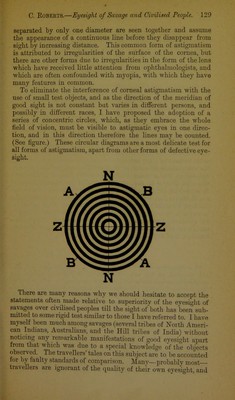
![were known to have been taken under unfavourable conditions of illumination, the results appear to me to be quite trustworthy, as they conform when grouped in the usual manner to the well- known “ law of error.” The groups increase in a fairly uniform manner from four observations at and under 5 feet, up to 272 observations at 50-60 feet, and then diminish in a similar manner to four observations at 110 feet and upwards ; the mean or largest group being, at 57’5 feet, identical with the theoretical distance at which the dots are visible to persons with good eyesight. The difference, moreover, between the eyesight of town folk and of country folk, as shown by these statistics, is barely 4 per cent, in favour of the latter, a difference which is probably to be accounted for by the better light in the country. These results would seem to show that the varying distances between the dots on the test card is not a vital objection to their use, as the result depends on the power of the eyes to separate the dots which are nearest together, and these are always separated by one diameter. It would be desirable, however, in altering these tests, or in devising new ones, to avoid this possible source of error and arrange the test objects, whatever form they may take, at equal distances from each other. [A diagram was here exhibited showing the effect of grouping the test dots at distances of cne, two, three, four, and five diameters apart, and the increasing distances at which each set is visible.]1 In arranging tests for eyesight sufficient attention has not been given to the interference with their use which astigmatism produces. This defect of sight is much more common than is generally supposed, being according to my experience rarely absent in adult persons, but has not received so much attention as other defects of sight because it does not in some of its forms materially interfere with the ordinary use of the eyes. In these cases there is a meridian of the eye which possesses the proper focal length lying between two portions which are imperfect. In the ordinary use of the eyes the meridian of good sight is made, by the rapid movements of the eyeball, to range over the object to which attention is directed and a sufficiently clear image of it is formed on the retina, but it is quite otherwise when the attention is fixed on a small object like a test dot or a test- type. In this case the test object becomes elongated in a direction at right angles to the meridian of good vision, and hence dots 1 It must be borne in mind that these test dots are used in the British army a8 a minimum test, and any recruit who cannot distinguish them at a distance of 15 feet is rejected as unfit for military duties, as he would be unable to see a bull’s-eye target 2 feet square at a distance of 600 yards. The instructions for carrying out this examination of recruits are unfortunately introduced in the “ Notes and Queries,” and they must be very puzzling to persons not accustomed to testing eyesight.](https://iiif.wellcomecollection.org/image/b22447106_0006.jp2/full/800%2C/0/default.jpg)