Inbreeding and outbreeding : their genetic and sociological significance / by Edward M. East ... and Donald F. Jones ... 46 illustrations.
- East, Edward M. (Edward Murray), 1879-1938.
- Date:
- [1919], ©1919
Licence: Attribution-NonCommercial 4.0 International (CC BY-NC 4.0)
Credit: Inbreeding and outbreeding : their genetic and sociological significance / by Edward M. East ... and Donald F. Jones ... 46 illustrations. Source: Wellcome Collection.
95/320 (page 91)
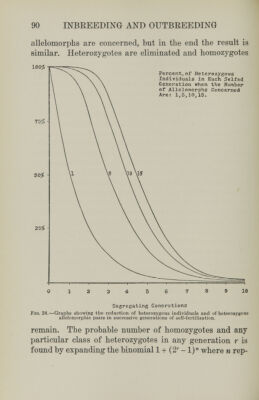
![MATHEMATICAL CONSIDERATIONS 91 resents the number of character pairs involved. The exponent of the first term gives the number of hetero¬ zygous and the exponent of the second term the number of homozygous characters. As an example, suppose we desire to know the probable character of the fifth segre¬ gating generation (Fq) when inbred, if three character pairs are concerned. Expanded we get 13 + 3 [P (31)] +8 [1 (31)2] (31)3 Eeducing, we have a probable fifth-generation population consisting of 1 heterozygous for three pairs; 93 hetero¬ zygous for two pairs; 2883 heterozygous for one pair; 28,791 homozygous in all three character combinations. Of the 32,768 total number of individuals in this genera¬ tion, 2977, or 9.09 per cent., are heterozygous in respect to some characters. Of the 98,304 total number of allelo- morphic pairs involved in all the individuals of this gen¬ eration, 3072, or 3.125 per cent., are heterozygous. This is the percentage which is obtained by halving 100 per cent, five times. It is the per cent, of heterozygous allelo- morphic pairs in all the individuals making up the popu¬ lation as a whole that follows curve 1 in Fig. 24. The per cent, of individuals heterozygous in any factors in any generation inbred by self-fertilization depends upon the number of heterozygous elements concerned at the start. The curves where 1, 5, 10 and 15 heterozygous allelo¬ morphs are present in the beginning are given in Fig. 24. These are calculated from the formula given and illus¬ trated above. The curve for the reduction in hetero¬ zygous individuals where one factor only is concerned at the start, is identical with the curve showing the reduction in the number of heterozygous factors in an inbred popu-](https://iiif.wellcomecollection.org/image/b18025730_0096.JP2/full/800%2C/0/default.jpg)