On the digestive ferments and the preparation and use of artificially digested food : being the Lumleian Lectures for the year 1880. Delivered before the Royal College of Physicians / by Wm. Roberts.
- William Roberts
- Date:
- 1881
Licence: Public Domain Mark
Credit: On the digestive ferments and the preparation and use of artificially digested food : being the Lumleian Lectures for the year 1880. Delivered before the Royal College of Physicians / by Wm. Roberts. Source: Wellcome Collection.
Provider: This material has been provided by the Augustus C. Long Health Sciences Library at Columbia University and Columbia University Libraries/Information Services, through the Medical Heritage Library. The original may be consulted at the the Augustus C. Long Health Sciences Library at Columbia University and Columbia University.
42/92 page 30
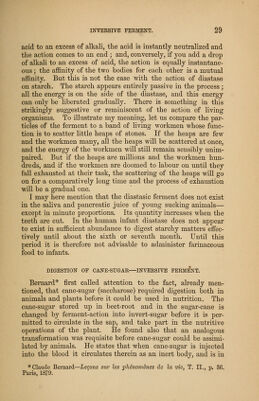
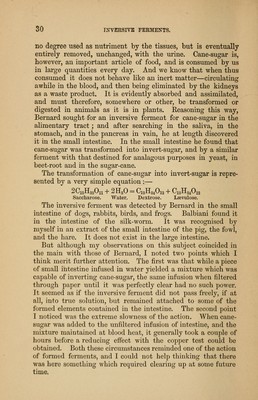
![no degree used as nutriment by the tissues, but is eventually entirely removed, unchanged, with the urine. Cane-sugar is, however, an important article of food, and is consumed by us in large quantities every day. And we know that when thus consumed it does not behave like an inert matter—circulating awhile in the blood, and then being eliminated by the kidneys as a waste product. It is evidently absorbed and assimilated, and must therefore, somewhere or other, be transformed or digested in animals as it is in plants. Reasoning this way, Bernard sought for an inversive fermeut for cane-sugar in the alimentary tract; and after searching in the saliva, in the stomach, and in the pancreas in vain, he at length discovered it in the small intestine. In the small intestine he found that cane-sugar was transformed into invert-sugar, and by a similar ferment with that destined for analagous purposes in yeast, in beet-root and in the sugar-cane. The transformation of cane-sugar into invert-sugar is repre- sented by a very simple equation :— 2C12H22O11 + 2H2O = C12H24O12 + C12H24O12 Saccharose. Water. Dextrose. Lsevulose. The inversive ferment was detected by Bernard in the small intestine of dogs, rabbits, birds, and frogs. Balbiani found it in the intestine of the silk-worm. It was recognised by myself in an extract of the small intestine of the pig, the fowl, and the hare. It does not exist in the large intestine. But although my observations on this subject coincided in the main with those of Bernard, I noted two points which I think merit further attention. The first was that while a piece of small intestine infused in water yielded a mixture which was capable of inverting cane-sugar, the same infusion when filtered through paper until it was perfectly clear had no such power. It seemed as if the inversive ferment did not pass freely, if at al], into true solution, but remained attached to some of the formed elements contained in the intestine. The second point I noticed was the extreme slowness of the action. When cane- sugar was added to the unfiltered infusion of intestine, and the mixture maintained at blood heat, it generally took a couple of hours before a reducing effect with the copper test could be obtained. Both these circumstances reminded one of the action of formed ferments, and I could not help thinking that there was here something which required clearing up at some future time.](https://iiif.wellcomecollection.org/image/b21209303_0042.jp2/full/800%2C/0/default.jpg)
 No text description is available for this image
 No text description is available for this image
 No text description is available for this image