Report of the New Guinea nutrition survey expedition, 1947 / [edited by E.H. Hipsley and F.W. Clements].
- Australia. Department of External Territories
- Date:
- [1947?]
Licence: In copyright
Credit: Report of the New Guinea nutrition survey expedition, 1947 / [edited by E.H. Hipsley and F.W. Clements]. Source: Wellcome Collection.
264/316 page 260
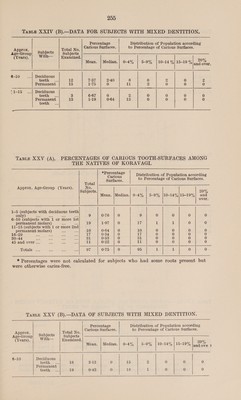
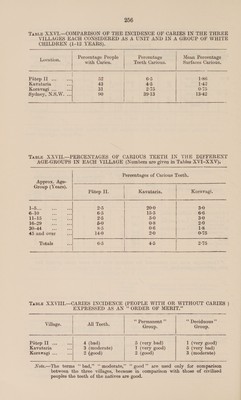
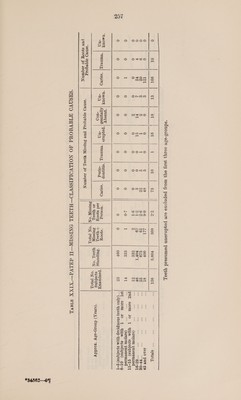
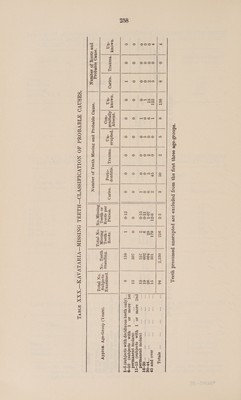
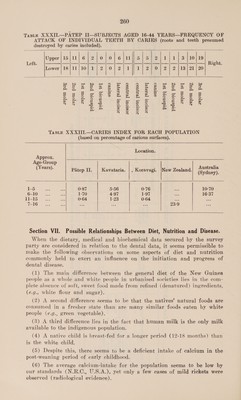
![Taste XXXII.—PATEP II—SUBJECTS AGED 16-44 YEARS—FREQUENCY OF ATTACK OF INDIVIDUAL TEETH BY CARIES (roots and teeth presumed destroyed by caries included). Upper }15/11);6}2,;0/0/]6/11]/5)5)2)1/)]121 43 /10)19 Left. —|— | —-|— || — | — | — || —| —|— |_| |_| Right. Lower |18j}11/10;}1)/2/0/]2]1), 1) 2] 0] 2] 2 |13/21 | 20 i) bo = b © gee) i) yaad — bo eM KO W& 2 Bie eee eee oe BRE gEe LE PB eG Ree ss > Sp ¢ & B og igs B ae Ss & F wee | Tee © 6 6 & Sem & ete Q. ta) bate nD mM [om <r = 58.8 5 5 Taste XX XIITIT.—CARIES INDEX FOR EACH POPULATION (based on percentage of carious surfaces). Location. Approx. Age-Group : fede Patep II. | Kavataria. | , Koravagi. [New Zealand. cole 1-5 as ras 0-87 5-56 0-76 se 10-70 G10... ee 1-70 4:97 1-97 vas 16-37 11-15... ae 0-64 1-23 0-64 as te 7-16 is “ee ao 23-9 Section VII. Possible Relationships Between Diet, Nutrition and Disease. When the dietary, medical and biochemical data secured by the survey party are considered in relation to the dental data, it seems permissible to make the following observations on some aspects of diet and nutrition commonly held to exert an influence on the initiation and progress of dental disease. (1) The main difference between the general diet of the New Guinea people as a whole and white people in urbanised societies lies in the com- plete absence of soft, sweet food made from refined (denatured) ingredients, (e.g., white flour and sugar). (2) A second difference seems to be that the natives’ natural foods are consumed in a fresher state than are many similar foods eaten by white people (e.g., green vegetable). (3) A third difference lies in the fact that human milk is the only milk available to the indigenous population. (4) A native child is breast-fed for a longer period (12-18 months) than is the white child. (5) Despite this, there seems to be a deficient intake of calcium in the post-weaning period of early childhood. (6) The average calcium-intake for the population seems to be low by our standards (N.R.C., U.S.A.), yet only a few cases of mild rickets were observed (radiological evidence).](https://iiif.wellcomecollection.org/image/b32179960_0264.jp2/full/800%2C/0/default.jpg)