Further observations on the treatment of spasmodic torticollis / by Maurice H. Richardson and George L. Walton.
- Richardson, Maurice H. (Maurice Howe), 1851-1912.
- Date:
- 1896
Licence: Public Domain Mark
Credit: Further observations on the treatment of spasmodic torticollis / by Maurice H. Richardson and George L. Walton. Source: Wellcome Collection.
Provider: This material has been provided by The Royal College of Surgeons of England. The original may be consulted at The Royal College of Surgeons of England.
15/18 page 13
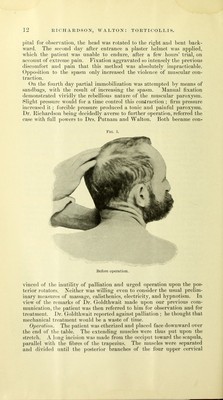
![nerves were found, of which all branches were avulsed, including the great occipital. Most of the muscles were also cut across, the trachelo- mastoid alone remaining intact. December 5th. The head still rotates to the right, though with less violence than before and with longer intermissions. One of the dee]) muscles, apparently the trachelo-mastoid, can be felt to harden spasmod- ically duriug rotation. This is the nerve, the patient states, which has seemed to him the principal cause of the trouble throughout. Massage is begun to-day. ' 11th. Examination shows a strong spasmodic contraction of the trapezius and of the trachelo-mastoid. It is proposed to treat these muscles persistently by massage and by other remedies; in the event of failure after a reasonable time, free division of the remaining fibres will be made. 13th. Daily massage has been continued up to the present time. From the beginning of this treatment the spasm was considerably re- laxed. 14th. The head is now fairly quiet. The trapezius and trachelo- mastoid spasm seems to have largely disappeared, though after being up and about for some hours it reappears to a moderate extent. This patient, like the last, expresses himself as greatly pleased, and states that rather than return to his previous condition he would choose to have all muscles paralyzed and wear a collar. He adds that he was formerly so helpless that he could not sign checks, dress or feed himself. He gave his chief-clerk power of attorney for the former purpose, and required the assistance of his wife for the latter. When he attempted to go through a door he was in danger of striking the doorway. He used to sit holding his head in both hands, with elbows resting on something. He once attempted to ride, resting the elbows on the seat before him, but had to discontinue after riding a mile on account of distress. This patient was discharged December 14th. Whether this improve- ment is permanent or not we cannot say. The absolute immobilization by the operation of the greater portion of those muscles which produce the spasms may have relieved, in some obscure way, the one or two remaining muscles. It seems not impossible that those muscles remain- ing unimproved in an extensive co-ordinating group, the other.' of which have become for the time being paralyzed, may through their altered nerve-supply, or from some other cause connected with the operation, have been unable further to give expression, by spasm or otherwise, to the central or other source of irritation ; they may be too limited in size and in function to carry the burden of rebellion before distributed among so many muscles. On the other hand, we frequently see spasms shift from a single muscle to an extensive group, as in all those cases in which the posterior rotators become involved after avulsion of the spinal acces- sory. The burden of giving expression to the irritation is thereby divided, but we have never seen the spasm go further than this.](https://iiif.wellcomecollection.org/image/b22379435_0017.jp2/full/800%2C/0/default.jpg)