[Standard catalogue]. Section XXIV, Bacteriology and protozoology / Baird & Tatlock (London) Ltd.
- Baird & Tatlock (London) Ltd.
- Date:
- [between 1900 and 1909?]
Licence: In copyright
Credit: [Standard catalogue]. Section XXIV, Bacteriology and protozoology / Baird & Tatlock (London) Ltd. Source: Wellcome Collection.
82/98
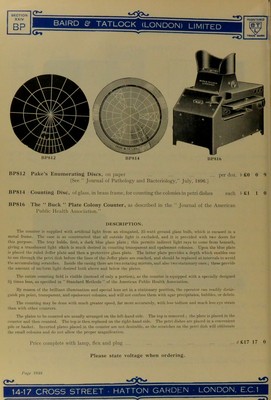
![r. SECTION XXIV BP tIAIKD t? TATLOCK (LONDON) LIMITFn REOISTEflCO BT ^ ^ thaotmajin BP812 BP814 BP816 i BP812 Fake’s Enumerating Discs, on paper (See “ Journal of Pathology and Bacteriology,” July, 1896.) per doz. 6 £0 0 9 BP814 Counting Disc, of glass, in brass frame, for counting the colonies in petri dishes each 6 £1 1 0 BP816 The “ Buck ” Plate Colony Counter, as described in the “ Journal of the American Public Health Association.” DESCRIPTION. The counter is supplied with artificial light from an elongated, 25-watt ground glass bulb, which is encased in a metal frame. The case is so constructed that all outside light is excluded, and it is provided with two doors for this purpose,. The tray holds, first, a dark blue glass plate ; this permits indirect light rays to come from beneath, giving a translucent light which is much desired in counting transparent and opalescent colonies. Upon the blue plate is placed the ruled Jeffer plate and then a protective glass plate. The latter plate provides a depth which enables one to see through the petri dish before the lines of the Jeffer plate are reached, and should be replaced at intervals to avoid the accumulating scratches. Inside the casing there are two rotating mirrors, and also two stationary ones ; these provide the amount of uniform light desired both above and below the plates. The entire counting field is visible (instead of onlj' a portion), as the counter is equipped with a specially designed 3J times lens, as specified in “ Standard Methods ” of the American Public Health Association. By reason of the brilliant illumination and special lens set in a stationary position, the operator can readily distin- guish ])in point, transparent, and opalescent colonies, and will not confuse them with agar precipitates, bubbles, or debris. The counting may be done with much greater speed, far more accurately, with less tedium and much less eye strain than with other counters. The plates to be counted are usually arranged on the left-hand side. The top is removed ; the plate is placed in the counter and then counted. The top is then replaced on the right-hand side. The petri dishes are placed in a convenient pile or basket. Inverted plates placed in the counter are not desirable, as the scratches on the petri dish will obliterate the small colonies and do not allow the proper magnification. Price complete with lamp, flex and plug .... ....d£17 17 0 Please state voltage when ordering. Page 1!H8](https://iiif.wellcomecollection.org/image/b28134321_0084.jp2/full/800%2C/0/default.jpg)