The book : the story of printing & bookmaking / by Douglas C. McMurtrie.
- Douglas Crawford McMurtrie
- Date:
- 1948
Licence: In copyright
Credit: The book : the story of printing & bookmaking / by Douglas C. McMurtrie. Source: Wellcome Collection.
98/744 page 62
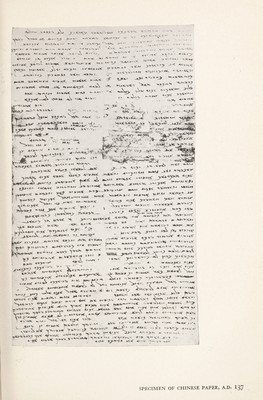
![In the first year of the Yiian-hsing period [a.d. 105] he made a report to the emperor on the process of papermaking and received high praise for his ability. From this time paper has been in use everywhere and is called the ‘paper of Marquis Ts‘ai.’ ” For the emperor ennobled Ts‘ai, and after the death of the marquis, although he poisoned himself when he was found to be implicated in a palace intrigue, a temple was erected to his memory. And even to this day, among the old-fashioned Chinese paper dealers, the apocryphal portrait of Ts‘ai Lun is sometimes found with incense sticks burning before it. This tradition of the invention of paper received amazingly clear confirmation from discoveries made in China by Sir Aurel Stein in 1907. In the sealed dustbin of a watch tower on an outlying segment of the Great Wall, near Tun-huang in Chinese Turkestan, this explorer made a rich find of a mass of documents written on wood and one or two on silk, and with them nine letters written on paper in the Sogdian script. None of these letters is dated, but as the Chinese documents found with them all belong to a period of not later than a.d. 137, it seems safe to say that the paper of the letters was made within fifty years from the date of Ts‘ai Lun’s official announcement. One of these letters, written on one of the oldest pieces of paper now in existence, is reproduced in the plate facing page 64, from the original in the British Museum. Microscopic examination has shown this ancient specimen to be a pure rag paper. Other specimens of paper of only slightly later date have been discovered by other explorers at various points in central Asia, usually with documents written on wood or on silk, showing that the use of the earlier writing materials had not been entirely supplanted. By the fifth century, however, the use of paper had become universal in China. A mere recital of the dates of the earliest known occurrence](https://iiif.wellcomecollection.org/image/b30009455_0098.jp2/full/800%2C/0/default.jpg)