The book : the story of printing & bookmaking / by Douglas C. McMurtrie.
- Douglas Crawford McMurtrie
- Date:
- 1948
Licence: In copyright
Credit: The book : the story of printing & bookmaking / by Douglas C. McMurtrie. Source: Wellcome Collection.
99/744 page 63
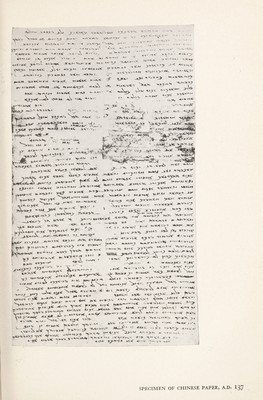
![■ 5 ;] ; ■ ) 1 of paper at different points tells much of the history of this now universal material for writing and printing and of its gradual move¬ ment westward. After its origin in central China in a.d. 105, it was in use at Tun-huang in Chinese Turkestan by a.d. 150; also in Chinese Turkestan but farther west, at Lou-lan, in a.d. 200 and at Turfan in 399; at Gilghit in Kashmir in the sixth century; at Samarkand in 751; at Bagdad in 793; in Egypt in the year 900 or perhaps earlier; at Fez in Morocco about 1100; at Jativa (or Xativa), Spain, in 1150; at Fabriano, Italy, about 1270; at Nurem¬ berg, Germany, in 1390; in England not until 1494; and finally it was manufactured for the first time on the American continent at Philadelphia in 1690. How graphic a story even this brief schedule tells! Chart it on a map, and it is still more impressive. Set it beside the outstanding dates in the history of Europe and try to visualize all that befell European civilization while the manufacture and use of paper was so slowly spreading. Long before paper became the helpmate of printing in Europe, it had played its part in the vast movements of races in Asia and in the minglings and interchanges of Oriental cultures for centuries. Powerful forces helped the spread of paper and also prevented its earlier arrival in the western world. Three mighty religions played their part in its history before it ever reached Europe. The zeal of Buddhist missionaries, with their peculiar enthusiasm for the endless repetition and multiplication of their sacred texts, seized on paper as a means of spreading their faith throughout China and Japan. The Nestorian Christians, penetrating central Asia in the fifth and sixth centuries, must have known of it and used it, although none of their documents written on paper have survived. On the other hand, the Mohammedans, represented by the all-con¬ quering Arabs, closed to Europe the ancient trade routes, and thus](https://iiif.wellcomecollection.org/image/b30009455_0099.jp2/full/800%2C/0/default.jpg)