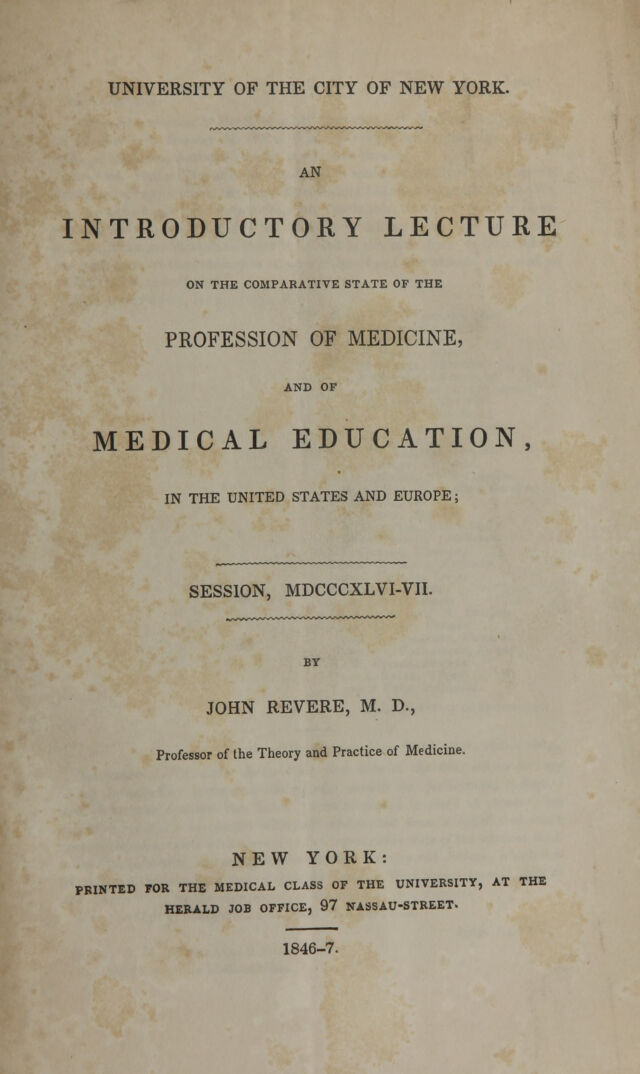
An introductory lecture on the comparative state of the profession of medicine, and of medical education in the United States and Europe : session MDCCCXLVI-VII / by John Revere.
- John Revere
- Date:
- 1846-7 [i.e. 1846]
Licence: Public Domain Mark
Credit: An introductory lecture on the comparative state of the profession of medicine, and of medical education in the United States and Europe : session MDCCCXLVI-VII / by John Revere. Source: Wellcome Collection.
Provider: This material has been provided by the National Library of Medicine (U.S.), through the Medical Heritage Library. The original may be consulted at the National Library of Medicine (U.S.)
7/20
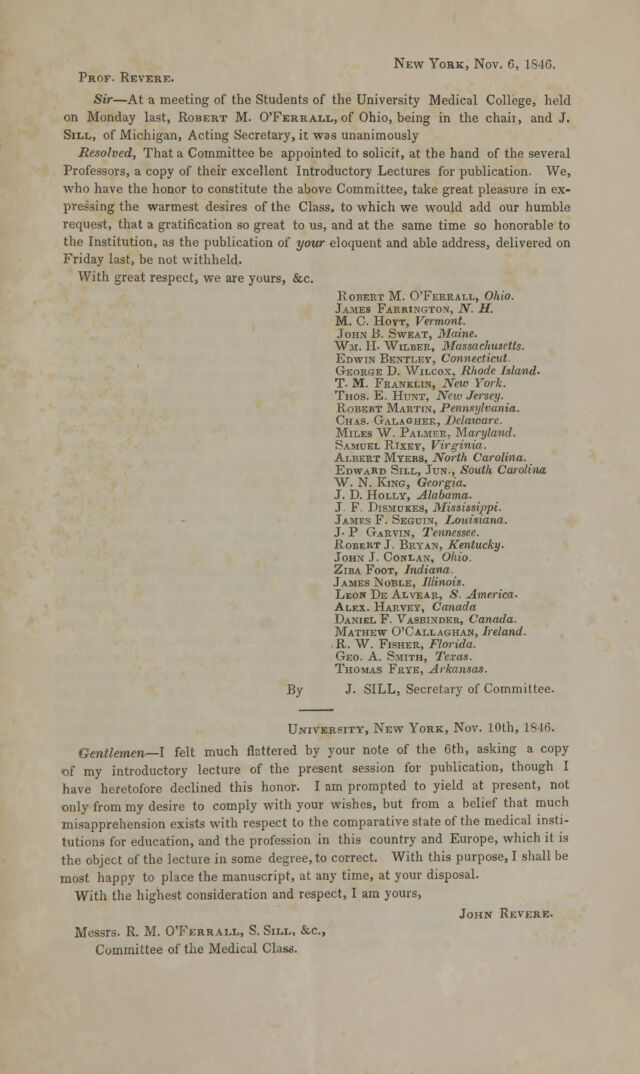
![since visited the chief medical schools of Europe. Having, likewise, had the honor to be connected, during the last fifteen years, as a pro- fessor of the practice of medicine with two among the largest medical schools of the United States, Jefferson Medical College, Philadelphia, and this institution, I have been necessarily thrown into extensive personal intercourse with the members of the profession in almost every part of the United States. I have thus had within my reach an opportunity of comparing the state of the profession in this country with that of some of the nations of Europe. I will now endeavor to draw, briefly, what seems to me a just and fair comparison between them. Let us, then, compare the mass of medical practitioners in Great Britain, perhaps the most enlightened country in Europe, with those of our own, and, on a fair comparison, I assert that the disadvantage, in many respects, is not with us. It is indispensable, in making this com- parison, to keep in view the fact, that the organization of the profession is essentially different in the two countries. In Great Britain the medical men are divided into three classes, viz., Apothecaries, Surgeons and Physicians. Nearly all the practice, except on extraordinary oc- casions, is in the hands of the apothecaries and surgeons, who consti- tute the mass—nineteen-twentieths of the medical men. The elite of the profession consists of the doctors of medicine, and the higher class of operating surgeons (whose practice is chiefly consultation) and constitute but a small fraction of the mass. In this country, as you know, this division of labor does not obtain. Here the profession is a unit—all the regular members being educated avowedly for the purpose of practising all the branches. Keeping this in view, then, it may be safely asserted that if many of our medical men have defective early \ education, yet, the remark applies with quite as much force to the mass of practitioners in Great Britain. This is unavoidable from the very circumstances in which they are placed. The medical practi- tioners, in Great Britain, are generally bound apprentices to sur- geons and apothecaries at an early age, before they have had time to receive a proper elementary education, where they remain until they are twenry-one years of age, and are in a condition to begin to practice themselves. In their character of apprentices, they are kept confined to the shops and surgeries of their masters for from five to seven years, with little other opportunity for improvement than in attending the lectures necessary for passing either Apothecaries Hall or the College of Surgeons. These persons are generally taken from the humbler conditions in society, and have few opportunities of intellectual im- provement at home in their intercourse with their families, while their positive social rank in that country is very low. Hence, though we occasionally see individuals, by force of talent, rising to the highest professional rank, yet usually the stamp of this defective education is ineffaceable. This was strikingly shown in the language of one of the most eminent British surgeons of modern times. To this I may \ add, that the London medical schools, to which those chiefly resort who ] merely intend to pass their examinations at the Apothecaries Hall or](https://iiif.wellcomecollection.org/image/b21150138_0007.jp2/full/800%2C/0/default.jpg)



 No text description is available for this image
 No text description is available for this image
 No text description is available for this image