A text-book of medicine for students and practitioners / by Dr. Adolf Strümpell.
- Adolph Strümpell
- Date:
- 1895
Licence: Public Domain Mark
Credit: A text-book of medicine for students and practitioners / by Dr. Adolf Strümpell. Source: Wellcome Collection.
Provider: This material has been provided by the Augustus C. Long Health Sciences Library at Columbia University and Columbia University Libraries/Information Services, through the Medical Heritage Library. The original may be consulted at the the Augustus C. Long Health Sciences Library at Columbia University and Columbia University.
68/1090 page 38
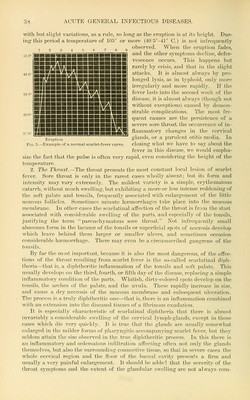
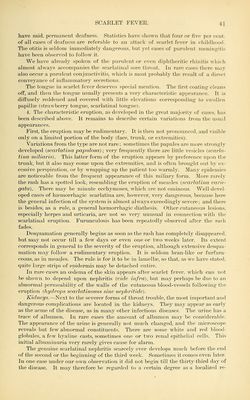
![with but slight variations, as a rule, so long as the eruption is at its height. Dur- ing this period a temperature of 105° or moi'e (40'.'>°-41° C.) is not infrequently ., ^ „ observed. When the eruption fades, ■■^ffiaHaramiHHHHHHiaHi ■■■■■■■■■^^■■■■■■i ■■■■■■■■■^^■■■■■■l ■■■■■■■■■■■■v«mbhShi ■Ml ■■■■■■■■■■■■■M«l ■(■■■■■■■■■■■KHI HI JJBHBHBHHHHni {{■■■■■■■■■■■■■Ml and the other symptoms decline, defer- vescence occurs. This happens but rarely by crisis, and that in the slight attacks. It is almost always by pro- longed lysis, as in typhoid, only more irregularly and more rapidly. If the fever lasts into the second week of the disease, it is almost always (though not without exceptions) caused by demon- sti'able com])lications. The most fre- quent causes are the pei'sistence of a severe sore throat, the occurrence of in- flammatory changes in the cervical glands, or a purulent otitis media. In Frc. 5.—Example of a normal scarlet-fever curve. closing what we have to say about the fever in this disease, we would empha- size the fact that the pulse is often very rapid, even considering the height of the temperature. 2. The Throat.—The throat presents the most constant local lesion of scarlet fever. Sore throat is only in the rarest cases wholly absent; but its form and intensity may vary extremely. The mildest variety is a simple, erj-thematous catarrh, without much swelling, but exhibiting a more or less intense reddening of the soft palate and tonsils, frequently associated with enlargement of the little mucous follicles. Sometimes minute hasmorrhages take place into the mucous membrane. In other cases the scarlatinal affection of the throat is from the start associated with considerable swelling of the parts, and especially of the tonsils, justifying the term parenchymatous sore throat. Not infrequently small abscesses form in the lacunas of the tonsils or superficial spots of necrosis develop which leave behind them larger or smaller ulcers, and sometimes occasion considerable hajmorrhage. There may even be a circumscribed gangrene of the tonsils. By far the most important, because it is also the mo.st dangerous, of the afFec- tions of the throat resulting from scarlet fever is the so-called scarlatinal dipii- theria—that is, a diphtheritic inflammation of the tonsils and soft palate. This usually develops on the third, fourth, or fifth day of the disease, replacing a simple inflammatory condition of the parts. Whitish, dirty-colored spots develojj on the tonsils, the arches of the palate, and the uvula. These rapidly increa.se in size, and cause a dry necrosis of the mucous membrane and subsequent ulceration. The process is a truly diphtheritic one—that is, there is an inflammation combined with an extension into the diseased tissues of a fibrinous exudation. It is especially characteristic of scarlatinal diphtheria that there is almo.st invariably a considerable swelling of the cervical lymph-glands, except in those cases which die very quickly. It is true that the glands are usually somewhat enlarged in the milder forms of iiharyngitis accompanying scarlet fever, but they seldom attain the size obsei-ved in the true diphtheritic process. In this there is an inflammatory and cedematous infiltration affecting often not only the glands themselves, but also the surrounding connective tissue, so that in severe cases the whole cervical region and the floor of the buccal cavity presents a firm and usually a very painful enlargement. It should be adde'l that the severity of the throat symptoms and the extent of the glandular swelling are not always com-](https://iiif.wellcomecollection.org/image/b21206302_0068.jp2/full/800%2C/0/default.jpg)
 No text description is available for this image
 No text description is available for this image
 No text description is available for this image