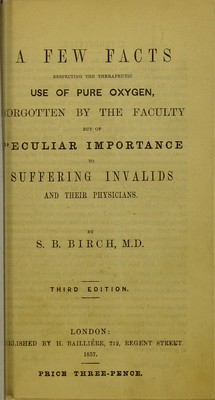
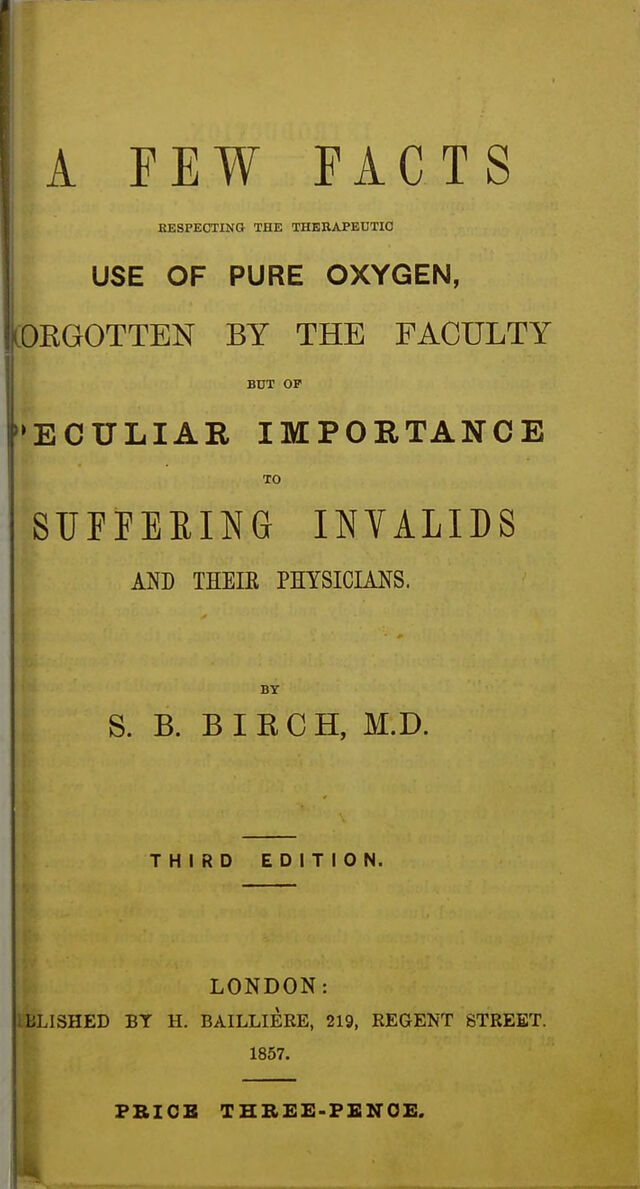
A few facts respecting the therapeutic use of pure oxygen, forgotten by the faculty but of peculiar importance to suffering invalids and their physicians / by S.B. Birch.
- Date:
- 1857
Licence: Public Domain Mark
Credit: A few facts respecting the therapeutic use of pure oxygen, forgotten by the faculty but of peculiar importance to suffering invalids and their physicians / by S.B. Birch. Source: Wellcome Collection.
Provider: This material has been provided by the Royal College of Physicians of Edinburgh. The original may be consulted at the Royal College of Physicians of Edinburgh.
6/28 page 4
![for the relief of present suffering, or the derangement of som( function ; and that which is directed to remedy the priman (. cause of the suffering or derangement. The one is palliative i merely relieving the effects of a diseased condition ; the othei is curative, by restoring the diseased condition to health s As an instance, the pain of gout or rheumatism is not tht ^i. disease, but the effects of it. To relieve the temporary paic t] is not curing the disease ;—to cure the disease we must attack i: the cause—that removed, its effect (the pain) will necessarily : eease. The liver may he torpid and refuse to secrete bile, -s but it by no means follows that the fault is in the liver!-j: Instead of flogging the sluggish liver with mercurials, it is sound practice to enquire,—Why is the liver sluggish ? Tht organ may be too active and secrete an excess of bile, and: pour this excess out till the intestinal canal is deluged, the bowels become disturbed, the tissues saturated, and the skin r coloured by the quantity absorbed. Yet by no means does it : follow that we must blame the liver for all this disturbance; we might as well inculpate the bowels for troubling us witi bilious diarrhoea ; or the skin because it cannot help looking • yellow. Again, constipation is not necessarily a disease of th( ■ bowels, it may be presented as the effect of a diseased con- dition of some other organ, therefore to relieve constipation by purgative medicine is not curative treatment but palliative; if we discontinue the purgative the constipation may remain persistent, and generally does. If we examine an organ after death and find its structure altered, it being known that , its function was impaired during life, we are not constrained to charge the altered structure as the cause of its disturbed function, the latter may have been the cause of altered struc- ture, and the primary cause have existed in some other organ. We might pursue this theme, but have merely given an ex- • ample to impress on the non- medical reader that the cause of disease is one thing, the effect of disease another; and that the treatment of causes, instead of their effects, will inevitably tend to change medical practice from an art, in the exercise of which assiduous attention and profound learninml are often barren in their results, and elevate it to a positiom^ in which true science will lead the physician primarily t'A^ aissail the source of diseased actions. We venture to set forth a truism which must be acknow- leged by our medical bi'cthren, (avc hope we do this no1](https://iiif.wellcomecollection.org/image/b21900607_0006.jp2/full/800%2C/0/default.jpg)