Orthodontia practically treated : designed for the use of both practitioner and student / by Miland A. Knapp.
- Knapp, Miland Austin, 1868-
- Date:
- 1904
Licence: Public Domain Mark
Credit: Orthodontia practically treated : designed for the use of both practitioner and student / by Miland A. Knapp. Source: Wellcome Collection.
Provider: This material has been provided by the Augustus C. Long Health Sciences Library at Columbia University and Columbia University Libraries/Information Services, through the Medical Heritage Library. The original may be consulted at the the Augustus C. Long Health Sciences Library at Columbia University and Columbia University.
364/424 (page 352)
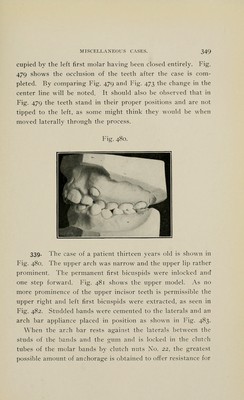
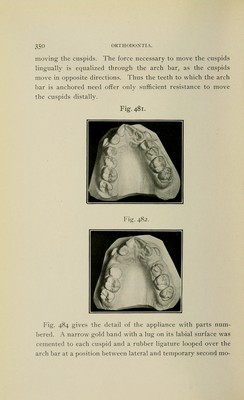
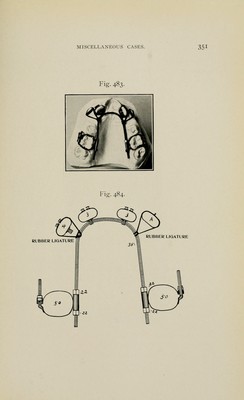
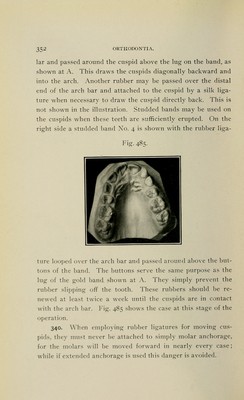
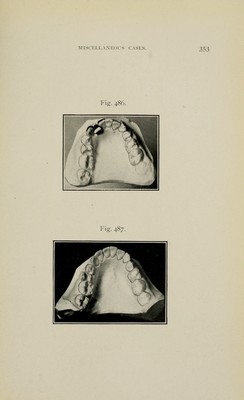
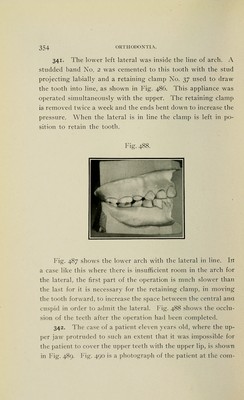
![lar and passed around the cuspid above the lug on the band, as shown at A. This draws the cuspids diagonally backward and into the arch. Another rubber may be passed over the distal end of the arch bar and attached to the cuspid by a silk liga- ture when necessary to draw the cuspid directly back. This is not shown in the illustration. Studded bands may be used on the cuspids when these teeth are sufficiently erupted. On the right side a studded band Xo. 4 is shown with the rubber liga- Fig. 485. ture looped over the arch bar and passed around above the but- tons of the band. The buttons serve the same purpose as the lug of the gold band shown at A. They simply prevent the rubber slipping off the tooth. These rubbers should be re- newed at least twice a week until the cuspids are in contact with the arch bar. Fig. 485 shows the case at this stage of the o],(-ration. 340. When employing rubber ligatures for moving cus- pids, tiny must never be attached to simply molar anchorage, for the molar- will be moved forward in nearly every case; while if extended anchorage i1- \]^^'\ this danger is avoided.](https://iiif.wellcomecollection.org/image/b21216277_0364.jp2/full/800%2C/0/default.jpg)