Volume 1
Reports of the Royal Commission appointed to inquire into the subject of Vaccination; with minutes of evidence and appendices / Vaccination Commission.
- Great Britain. Royal Commission on Vaccination
- Date:
- 1889-1897
Licence: Public Domain Mark
Credit: Reports of the Royal Commission appointed to inquire into the subject of Vaccination; with minutes of evidence and appendices / Vaccination Commission. Source: Wellcome Collection.
Provider: This material has been provided by London School of Hygiene & Tropical Medicine Library & Archives Service. The original may be consulted at London School of Hygiene & Tropical Medicine Library & Archives Service.
45/510 (page 15)
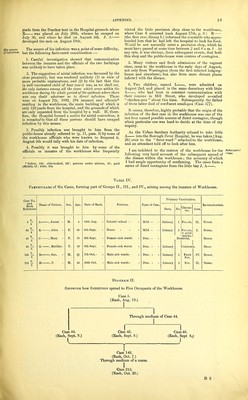
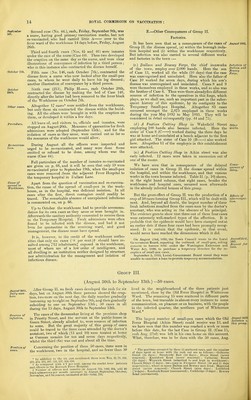
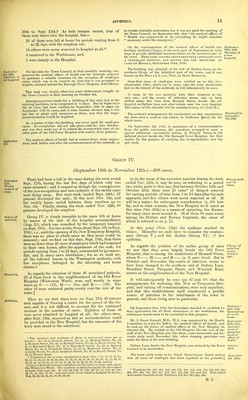
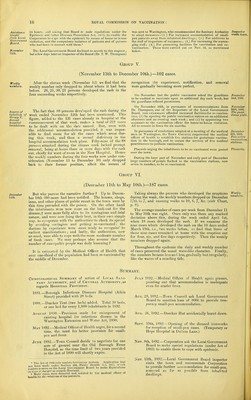
![30th to Sept. 13th? As beds became vacant, four of them were taken into the hospital, but— 26 of them were left at home for periods varying from 3 to 22 days with the eruption out. 14 others were never removed to hospital at all,* 4 remained in the Workhouse, and, 2 were already in the Hospital. On this date the Town Council, at their monthly meeting, em- powered the medical officer of health and the borough surveyor to purchase a suitable structure lor the receiition of small-pox cases, which was to be erected on land that it was proposed fo acouire, situated behind the Borough Fever Hospital, Aikin Street. This land was finally, after two years' deliberation, bought by the Town Council at their meeting on October 4th. Arrann-ements were made for a building of ;the same size as the existing°pavilions, to be completed in 14 days. But by September 8th 38 cases had been notified, by September 10th 46 cases, by September 12th 53 cases, and it soon became obvious that it was too late to adopt such measures as these, and that far larger accommodation would be required. As a matter of fact this building was never used for small-pox cases. Its completion did not take place until far into October, and was then made use of to relieve the overcrowded state of the other parts of the Old Fever Hospital with scarlet fever patients. The medical officer of health had at various times made sugges- tions, both before and after the commencement of the outbreak, as to certain desirable procedures, but it was not until the meeting of the Town Council, on September 6th, that the medical officer of Health was empowered to do everything he might consider necessary under the emergency. On the representation of the medical officer of health the lieptemher Sanitary Authority began, in the early part of Sc])tember, to take 1S92. steps to provide additional accommodation in the northern f art o!' '-'P'^ning of the town. Here some disused uionvvouks were converted into lio^pifril a temporary hospital, and opened for the reception o? cases on Monday, September 19th, 1892. The building was situated at the end of Dallam Lane, on the northern fringe of the inhabited part of the town, and it was known as the Dallam Lane, New, or Hope Hospital. Sixty-four cases of small-pox were notified up to this time (September 19th), which was in many ways the most memorable date in the history of the outbreak, as will subsequently be seen. 11 cases in the old hospital were then removed to the new one; and the centre of infection seems also to have shifted about this time from Howard Street, beside the old hospital, to Dallam Lane and other streets near the new hospital. The causes of this transfer will be considered on p. 69 (Part II.). The ordinary arrangements for vaccination are that vaccinations are done once a week at one station in Golborne Street for the whole town. On September 7th, 1S92, in pursuance of a recommendation from the public vaccinator, the guardians arranged to open a special additional vaccination station, at Piiestly Street in the infected district beside the Old Borough Fever Hospital, for four weeks, for the purpose of carrying out re-vaccinations one day per week. Vaccination September Group IV. (September 18th to November 12th.)—308 cases. September nth. Weekly number of Source of infection. Situation, Isolation, There had been a lull in the cases during the week ended Sept. 17th, during the last five days of which only two cases occurred ; and it seemed as though the consequences of the non-recognition and non-isolation of the earlier cases were dying away. But next week (ended Sept. 24th), 27 persons developed the rash; 35 the next (Oct. 1st), and the weekly figure varied between these numbers up to Nov. 5th. Finally, during the week ended Nov. 12th, 88 persons developed the eruption. Group IV. is clearly traceable to the cases left at home by reason of the lack of the hospital accommodation (Aug. 23), which was remedied by the temporary hospital on Sept. 19th. For two weeks (from about Sept. 5th to Sept. 19th), i.e., until the opening of theiSew Temporary Hospital, there was no place to which cases as they arose could be removed ; and we find on this date, Sept. 19th, that there were no fewer than 40 cases of small-pox which had remained in their own homes, after the appearance of the rash, for periods varying from 7 to 21 days, surrounded by ignorance, dirt, and in many cases destitution ; for, as we shall see, all the infected houses in the Warrington epidemic, with few exceptions, belonged to the labouring and lower classes, t As regards the situation of these 46 unisolated patients, 28 of them lived in the neighbourhood of the Old Fever Hospital (Whitecross Ward), near, and mostly in same street as S (13), H (6a), and B (10). The other 18 were scattered pretty evenly over the rest of the town.J Thus we see that there were on Sept. 19th 46 persons each capable of forming a centre for the spread of the dis- ease, and it is not difficult to account for the continued increase in the number of cases. Eighteen of these 46 were never admitted to hospital at all; the others were, after Sept. 19th, removed as fast as accommodation could be provided in the ITew Hospital, but the resources of the town were taxed to the uttermost. * The numbors and positions oE these 11 unfeinoved cases are as follows —No. 19, in Howard Street, No. -23, in Howard Street, No. 28, in Howard Street, No. 2il, in Howard Street.No. 3.3, in Dixon Street, No. 36 in Knutstord Uoiiil, No. 24, in Wakefield Street, No. 3!), in Hostoetc Street No. 5ti, in Wakelield Street, No. .IS, in Hopwood Street, No. 47, in Selby Street, No. 59, in Kendrick Street, No. 48, in Brierly Street, No. 53, in Be.wse.v Road. t Numbers o£ the 4S cases unisolated on Sept. Ittth :—1 15,13, in, 21), 23, 24, 25, 2fi, 27, 28, 29, 3(1, 30f(, 31, 32, 33, 34, 35, 3G, 37, 38, 39„ 42, 43, 44, 45, 4fi, 47, 48, 4!l, 50, 51, 53, 51., 53, 56, 57, 58, 59, (iO, 61, 62, 63, and 64. X Cases ot dehiyed removal jciitteredover the town on Sept. 19th, not in tlie Whitecross Ward. The numbers in lirackets signify the days spent at homo with rash out. 31 (15), .30 (14), 37 (13), 40 (7), 43 (11), 49 (10), 50 (9), 51 (10), .W (9) ; and nine were never taken to hospital at all, viz., Nos. 33, 36, 32, 44, 45, 46, 68, 59, 55- As to the cause of the excessive number during th^ week ended Nov. 12th, it may be seen, on referring to a period two weeks prior to this one, that between October l4tli and October 26th there were 25 cases* of delayed removal for varying periods of time from 3 to 14 days after the rash appeared, and five others were never removed at all. It will be a matter for subsequent consideration (p. 69) how far, and in what manner, the New Hospital itself acted at this time (Oct. 26th) as a means of spreading the disease, for many cases arose around it. 36 of these 88 cases arose among the Dallam and Bewsey forgemen, the cause of which is referred to on p. 75. At this point (Nov. 12th) the epidemic reached its climax. Hereafter we only have to consider the contini;- ance (Group V.), and the decline (Group VI.) cf ttie epidemic. As regards the position of the earlier group of cases we saw that they arose largely beside the Old Fever Hospital, that is among tlie inhabitants of Howard Street, where S -, H , and B (p. 9, ante) lived. But in October and November the centre of infection seems to have been changed to the northern end of Dallam Lane, Stamford Street, Pierpoint Street, and Win wick Road, streets in the neighbourhood of the New Hospital. It will subsequently be seen (pp. 67 and 68) that the arrangements for enclosing this New or Temporary Hos- pital, and cutting off communications, were very imperfect, and that this establishment itself constituted a prolific source of infection to the inhal)itants of the town in general, and those living near in particular. On .September 21st, 1892, the Guardians decided to establish 14 days' quarantine for all fresh admissions to the workhouse, the workhouse board-room to be converted to that purpose. Mr. J. Guest Gornall, RIB., BLA., was appointed by the Health Committee to assist his father, the medical officer of health, and he took up the duties of medical officer at the New Hospital on October 4th. He resided at the Old Hospital like the rest of the stall'of the New Hospital, and, like them, came backwards and for- wards daily until November 9th, when sleeping provision was made for them at the new building. Climax tveek uiai its cause. ChaKi^of infection centre. October l89i. Sentemhtr list, 1892. Quarantine at work- house. September •Zith, 1892. Appoint- ■,ncii t of assistant nu'i/ical olfluerof health Dallam Lane, beside the New Hospital, was ordered by the Town October Council to be barricaded. 25?/t. The town clerk wrote to the Local Govermnent Board stating November that 30 cases of small-pox had been reported in the preceding ■ith 1892. • Numbers 182, ISS, 221, 1S3, 181,183, 1S9, 212, 193, 194,196,197,203, 2,35,198, 201, 205, 209, 211, 214, 220, 228,229, 232, and 231, Five others were never removed at all, Numbors 173,186,19tl, 213, 260. J3 4](https://iiif.wellcomecollection.org/image/b21363717_0001_0045.jp2/full/800%2C/0/default.jpg)