Volume 1
Reports of the Royal Commission appointed to inquire into the subject of Vaccination; with minutes of evidence and appendices / Vaccination Commission.
- Great Britain. Royal Commission on Vaccination
- Date:
- 1889-1897
Licence: Public Domain Mark
Credit: Reports of the Royal Commission appointed to inquire into the subject of Vaccination; with minutes of evidence and appendices / Vaccination Commission. Source: Wellcome Collection.
Provider: This material has been provided by London School of Hygiene & Tropical Medicine Library & Archives Service. The original may be consulted at London School of Hygiene & Tropical Medicine Library & Archives Service.
56/510 (page 26)
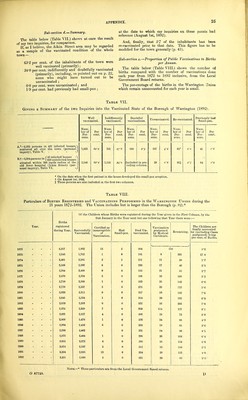
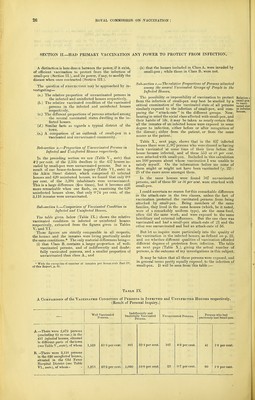
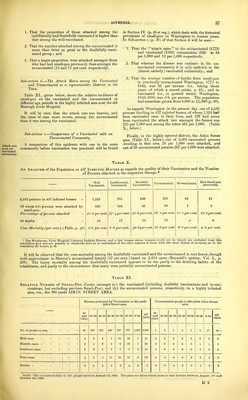
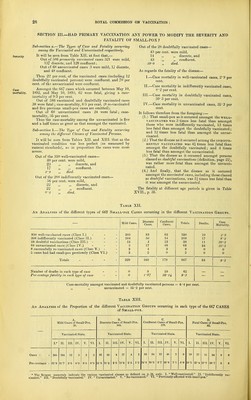
![SECTION II.—HAD PRIMARY VACCINATION ANY POWER TO PROTECT FROM INFECTION. A distinction is liere drav/n between the power, if it exist, of efficient vaccination to protect from the infection of small-pox (Section II.), and its power, if any, to modify the disease when once contracted (Section III.). The question of protection may he approached by in- vestigating— (a.) llie relative proportion of unvaccinated persons in the infected and uninfected houses respectively. (&.) The relative vaccinated condition of the vaccinated persons in the infected and uninfected houses respectively. (c.) The different proportions of persons attacked among the several vaccinated states dwelling in the in- fected houses. (d.) Similar facts as regards a typical district of the town. (e.) A comparison of an outbreak of small-pox in a vaccinated and unvaccinated community. Subsection a.—Proportion of Unvaccinated Persons in Infected and Uninfected Houses respectively. In the preceding section we saw (Table V., ante) that 4'2 per cent, of the 2,535 dwellers in the 437 houses in- vaded by small-pox were unvaccmated persons. But as a result of our house-to-house inquiry (Table VI., ante) in the Aikin Street district, which comprised 43 infected houses and 620 uninfected houses, we found that only 0'8 per cent, of the .3,394 inhabitants were unvaccinated. This is a large difference (five times), but it becomes still more remarkable when one finds, on examining the 620 uninfected houses alone, that only 074 per cent, of the 3,116 inmates were unvaccinated. Sub-section b.—Comparison of Vaccinated Condition in Infected and Uninfected Houses. The table given below (Table IX.) shows the relative vaccinated condition in infected or uninfected houses respectively, extracted from the figures given in Tables V. and VI. These figures are strictly comparable in all respects, the houses and the inmates were living practically under the same conditions.* The only material differences being— (i) that Class B. contains a larger proportion of well- vaccinated persons, and of indifferently and doubt- fully vaccinated persons, and a smaller proportion of unvaccinated than class A., and ; * With tbe exception of number! of inmates per ihouse vide Part IV. of this Report, p. 83. houses. (ii) that the houses included in Class A. were invaded by small-pox; while those in Class B. were not. Subsection c.—The relative Proportions of Persons attacked among the several Vaccinated Groups of People in the Infected Houses. The possibility or impossibility of vaccination to protect Relation from the infection of small-pox may best be studied by a t™^]^'^'^ critical examination of the vaccinated state of all persons naSstat! similarly exposed to the infection of small-pox, and com- in infeoteti paring the attack-rate in the different groups. Now, bearing in mind the social class aff ected with small-pox, and their habits of life, it may be taken as nearly certain that all the inmates of an infected house were exposed in some degree to infection, either before or after recognition of the disease; either from the patient, or from the same source as the patient. Table X., next page, shows that in the 437 infected houses there were 2,387 persons who were classed as having been vaccinated at some time of their lives before the house became infected, and of these 553 or 23 per cent. were attacked with small-pox. Included in this calculation are 100 persons about whose vaccination I was unable to satisfy myself. On the information before me some of them might or might not have been vaccinated (p. 22) : 25 of the cases arose amongst them. In the same houses were found 107 unvaccinated persons, and of these 60 or 36 per cent, were attacked with small-pox. I could ascertain no reason for this remarkable difference in the attack-rate in the two classes, unless the fact of vaccination protected the vaccinated persons from being attacked by small-pox. Being members of the same families, they lived in the same houses (which, be it noted, were of a remarkably uniform type), ate the same food, often did the same work, and were exposed to the same hereditary and external influences. But the one class was vaccinated and had a small-pox attack-rate of 21 and the other was unvaccinated and had an attack-rate of 56. But let us inquire more particularly into the quality of the vaccination in the infected houses, as defined on p. 22, and see whether different qualities of vaccination afforded different degrees of protection from infection. The table on next page (Table X.), giving the actual number of persons, is the outcome of my investigations in this subject. It may be taken that all these persons were exposed, and in general terms pretty equally exposed, to the infection of small-pox. It will be seen from this table :— Table IX. A Comparison of the Vaccinated Condition of Persons in Infected and Uninfected Houses respectively. (Result of Personal Inquiry.) Well Vaccinated Persons. Indifferently and Doubtfully Vaccinated Persons. Unvaccinated Persons. Persons who had previously had Small-pox. A.—There were 2,472 persons (excluding 63 re-vac.) in the 437 infected houses, situated in different parts of the town (see Table V., ante), of whom 1,523 61'6 per cent 801 32-4 per cent. 107 4-3 per cent. 41 16 per cent. B.—There were 3,116 persons in the 620 uninfected houses, situated in the Old Fever Hospital District (see Table VI., ante), of whom- 1,973 633 per cent 1,060 34-0 per cent. 23 0-7 percent. 60 1'9 per cent.](https://iiif.wellcomecollection.org/image/b21363717_0001_0056.jp2/full/800%2C/0/default.jpg)