Studies on the parasites of the termites / by Charles Atwood Kofoid and Olive Swezy. On streblomastix strix, a polymastigote flagellate with a linear plasmodial phase. On trichomitus termitidis, a polymastigote flagellate with a highly developed neuromotor system. On trichonympha campanula SP. Nov.On leidyopsis sphaerica Gen. Nov., Sp. Nov.
- Charles Atwood Kofoid
- Date:
- [1919]
Licence: Public Domain Mark
Credit: Studies on the parasites of the termites / by Charles Atwood Kofoid and Olive Swezy. On streblomastix strix, a polymastigote flagellate with a linear plasmodial phase. On trichomitus termitidis, a polymastigote flagellate with a highly developed neuromotor system. On trichonympha campanula SP. Nov.On leidyopsis sphaerica Gen. Nov., Sp. Nov. Source: Wellcome Collection.
118/152 page 96
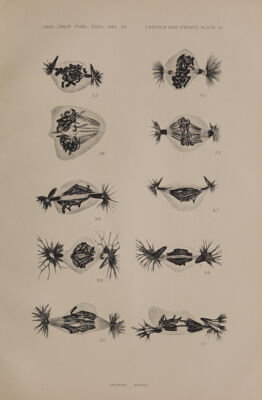
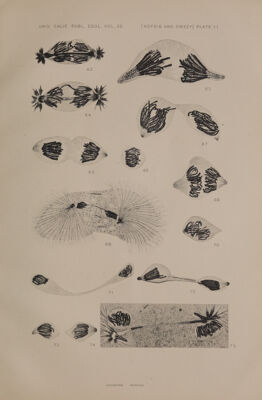
![Fig. 62. Anaphase; heterochromosome divided without apparent attach- - ment to spindle fibers. Fig. 63. Unusual appearance of chromatin granules strung along the spindle fibers. > 1250. Fig. 64. Anaphase; heterochromosome dividing. Fig. 65. Telophase of nucleus; constriction of the nuclear membrane. X 1250. Fig. 66. Daughter nucleus with division completed. Fig. 67. Telophase with nuclear constriction advancing. Spindle fibers disappearing at one pole, still intact at the other. X 1250. Fig. 68. Telophase showing surface ridges of the body. Centroblepharo- plasts still connected by the paradesmose. X 300. Fig. 69. Telophase of nucleus. Fig. 70. Daughter nucleus after constriction and prior to rounding up. Fig. 71. Greatly elongated nuclear band still connecting daughter nuclei. xX 300. Fig. 72. Completion of nuclear division with paradesmose still persisting. Figs. 73, 74. Sister nuclei recently divided. Fig. 75. Completion of nuclear division. Paradesmose beginning to fade out. [96]](https://iiif.wellcomecollection.org/image/b32766853_0118.jp2/full/800%2C/0/default.jpg)
 No text description is available for this image
 No text description is available for this image
 No text description is available for this image