Aids to the mathematics of hygiene / [Robert Bruce Ferguson].
- Ferguson, R. Bruce (Robert Bruce)
- Date:
- 1904
Licence: In copyright
Credit: Aids to the mathematics of hygiene / [Robert Bruce Ferguson]. Source: Wellcome Collection.
18/112 page 6
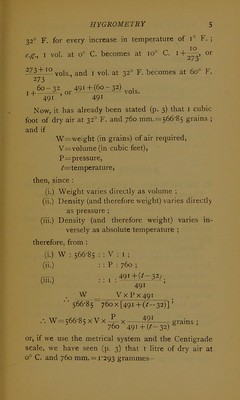
![. w_>'293xVxPx273 76a x (273 + /) grammes. Example : Find weight of 1 cubic foot of dry air at 6o° F. and 735 mm. \\t 566*85 xix 735 x 491 760 x [491+(60-32)] = 518 grains ; or, if we convert millimetres into inches (vide p. 4), we have 735 mm. = 29 inches ; and YV= 566*85 X I x 29 x 491 30 x [491+(60-32)] = 518 grains. AQUEOUS VAPOUR. To find the Weight of a Given Volume of Aqueous Vapour at a Given Temperature and Pressure. To find the weight of a vapour, the weight of the same volume of dry air at the same temperature and pressure must be sought, and this is then to be multi- plied by the relative density of the vapour. Example: Find the weight of a cubic foot of aqueous vapour at 6o° F. From a table of vapour-tensions (p. 93), we find that the maximum pressure which aqueous vapour can exert at 6o° F. = 13*167 mm. We have, therefore, to first find the weight of a cubic foot of dry air at 6o° F. and 13*167 mm. as follows (vide p. 4) : W= 566*85 x 13*167 x 491 _ 760 X [491 + (60 - 32)] 9*29 grams and this result must be multiplied by the relative](https://iiif.wellcomecollection.org/image/b28078160_0018.jp2/full/800%2C/0/default.jpg)



 No text description is available for this image
 No text description is available for this image
 No text description is available for this image