Volume 1
A treatise on comparative embryology / by Francis M. Balfour.
- Francis Maitland Balfour
- Date:
- 1880-1881
Licence: Public Domain Mark
Credit: A treatise on comparative embryology / by Francis M. Balfour. Source: Wellcome Collection.
499/540 (page 479)
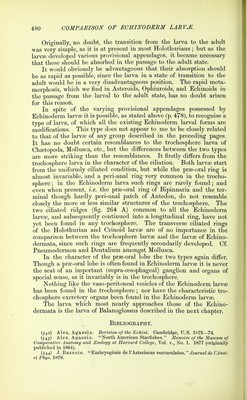
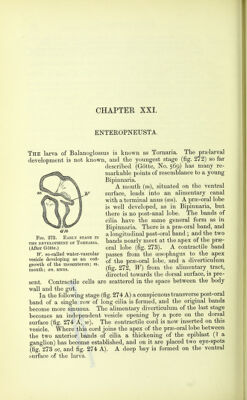
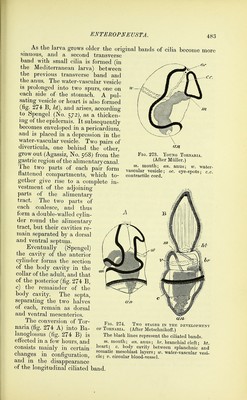
![Fig. 271. A. The larva of a Holo- THUROiD. B. The larva of an Asterias. m. mouth; st. stomach; a. anus- l.c primitive longitudinal ciliated band; \t c. prae-oral cihated band. The first group is characterised by the growth of a nuraber of arms more or less surrounding the mouth, and supported by cal- careous rods. The ciliated band retains its primitive condition as a simple longitudinal band throughout larval life. There is a very small prge-oral lobe, while an anal lobe is very largely developed. The Auricularia and Bipinnaria resemble each other in shape, in the development of a large prse- oral lobe, and in the absence of provisional calcareous rods; but differ in the fact that the ciliated band is single in Auricularia (fig. 271 A), and is double in Bipin- naria (fig. 271 B). The Bipinnaria larva shews a great tendency to develop soft arms ; while in the Auricularia the longitudinal ciliated band breaks up into a number of transverse ciliated bands. This condition is in some instances reached directly, and such larvae undoubtedly approximate to the larvae of Antedon, in which the uniformly ciliated condition is succeeded by one with four transverse bands, of which one is pr^e-oral ,^^^^^^derm larv^ are bilaterally symmetrica], and smce all Echniodermata eventually attain a radial symmetry a change necessarily takes place from the bilateral to the radial type In the case of the Holothurians and Antedon, and generally in the viviparous types, this change is more or less completely effected in the embryonic condition; but in the Bipinnaria and Pluteus types a radial symmetry does not become apparent till after the absorption of the larval appendages It is a remarkable fact, which seems to hold for the Asteroids, Ophiuroids, Echinoids, and Crinoids, that, the dorsal side t .1 ^\ converted into the dorsal disc of the adult- but the dorsal and right side becomes the adult dorsal or abactinal sll^face ^^ becomes the actinal or ventral It is interesting to note with reference to the larvse of the Echinodermata that the various existing types of larv^ must have been formed after the differentiation of the existing groups of the Echmodermata ; otherwise it would be necessary to adopt the im- possib e position that the different groups of Echinodermata were severally descended from the different types of larvae. The various special appendages, etc. of the different larvae have therefore a purelv secondary sigmficancej and their atrophy at the time of the passage of J^!. ^^^^^^ but a complicated metamorphosis, is easily explained. ^](https://iiif.wellcomecollection.org/image/b20415977_001_0499.jp2/full/800%2C/0/default.jpg)