Report of the Committee appointed by the Secretary of State for India to inquire into the rules, regulations, and practice in the Indian cantonments and elsewhere in India, with regard to prostitution and to the treatment of venereal disease : together with minutes of evidence and appendices.
- Great Britain. India Office. Committee on Prostitution in India.
- Date:
- 1893
Licence: Public Domain Mark
Credit: Report of the Committee appointed by the Secretary of State for India to inquire into the rules, regulations, and practice in the Indian cantonments and elsewhere in India, with regard to prostitution and to the treatment of venereal disease : together with minutes of evidence and appendices. Source: Wellcome Collection.
Provider: This material has been provided by Royal College of Physicians, London. The original may be consulted at Royal College of Physicians, London.
319/524 (page 269)
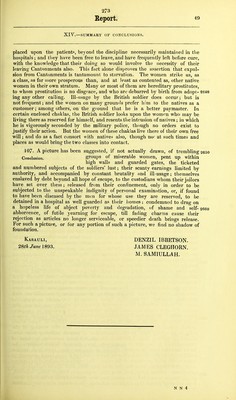
![Report. 45 XIV.—SUMMARY OF CONCLUSIONS. Meerut there were complaints of blackmailing against the sub- ordinate hospital staff. (25) Some few doubtless live in abject poverty, as some members of every class always will do; but they are very few, and the24io women as a class are comfortably and in many cases exceed- ingly well off, far more so than most native women in their stratum of life. All our evidence goes against the statement that they generally get into debt to the mahaldarni; but it is probable that they] often do so, like prostitutes all over the world. Like almost all natives, they deal on credit for their daily supplies; and are therefore generally in debt to some outside creditor ; though most of them we believe to be perfectly solvent. (28) Some few of them are probably therefore unable to quit the Can- 2420 tonment, as is the case with many of all the poorer classes of natives. But these women do constantly quit Cantonments in considerable numbers. (29) Their life is not a life of shame, in the sense in which this is true in England. Most of them are prostitutes by caste, and can feel no desire to give it up. Those who do feel such a desire would doubtless occasionally be prevented by debt; but far more often by the almost entire absence in India of all remunerative occu- pation for women, save hereditary occupation, to which caste restrictions would in most cases be an absolute bar, or manual 24S0 labour, for which they are unsuited. (30) Many of them undoubtedly live in the Cantonments as soldiers' prostitutes, until (unless they sooner die) they are too old for the purpose intended, when they are replaced by more attractive women. But this is seldom the result of anything that has been discussed before, or of any inability to quit Cantonments at pleasure; but simply because they prefer so to live. If we sub- situte servants for prostitutes, and active men for attractive women, the sentence stands true of hundreds of 2440 residents in Cantonments. (31) The prostitutes are generally not girls, but women of over 20 years old; few of them being very young, and only two out of 143 examined by us being apparently fifteen years of age or under. (32) When a regiment changes its Cantonment, women associated with that regiment not unfrequently accompany it on the march; as do numerous other persons who find their liveli- hood in ministering to the wants of the soldiers. All alike travel in carts, always paid fur, and sometimes hired by, them- selves ; but more often provided for their transport by the authori- 2450 ties, on indent for private carriage for the use of the numerous unpaid followers of the regiment. They are never sent by rail- way. During their progress they are never protected by European guards ; though they may, in rare instances, march behind carts travelling under guards. They are accompanied by the mahal- darni, who is one of themselves. (33) There is no woman entered on the register, because there is no register. At Ambala, up to August 1892, the women who were allowed to live in regimental chaklas, and at Meerut, up to a month ago, all the prostitutes of Cantonments, were required to present them- 2460 selves for periodical examination by the appointed Medical Officer at the hospital established in each Cantonment for the treatment N N 2 (26) (27)](https://iiif.wellcomecollection.org/image/b24758942_0321.jp2/full/800%2C/0/default.jpg)