Report of the Committee appointed by the Secretary of State for India to inquire into the rules, regulations, and practice in the Indian cantonments and elsewhere in India, with regard to prostitution and to the treatment of venereal disease : together with minutes of evidence and appendices.
- Great Britain. India Office. Committee on Prostitution in India.
- Date:
- 1893
Licence: Public Domain Mark
Credit: Report of the Committee appointed by the Secretary of State for India to inquire into the rules, regulations, and practice in the Indian cantonments and elsewhere in India, with regard to prostitution and to the treatment of venereal disease : together with minutes of evidence and appendices. Source: Wellcome Collection.
Provider: This material has been provided by Royal College of Physicians, London. The original may be consulted at Royal College of Physicians, London.
334/524 (page 284)
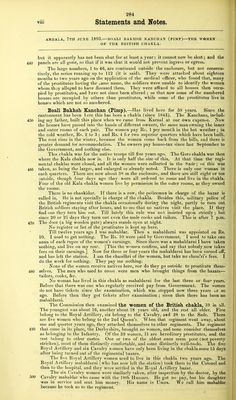
![AMBALA, 7TH JUNE 1893.—BOALI BAKHSH KAN CHAN (PIMP)—THE WOMEN OF THE BRITISH CHAKLA. but it apparently has not been shut for at least a year : it cannot now be shut; and the 440 panels are all gone, so that if it was shut it would not prevent ingress or egress. The large numbers, 1 to 46, are continued outside the enclosure, but not consecu- tively, the series running up to 112 (it is said). They were attached about eighteen months to two years ago on the application of the medical officer, who found that, many of the prostitutes having the »ame name, the soldiers were unable to identify the women whom they alleged to have diseased them. They were affixed to all houses then occu- pied by prostitutes, and have not since been altered ; so that now some of the numbered nouses are occupied by others than prostitutes, while some of the prostitutes live in houses which are not so numbered. Boali Bakhsh Kanchan (Pimp).—Has lived here for 50 years. Since the cantonment has been here this has been a chakla (since 1843). The Kanchans, inrlud- 450 ing my father, built this place when we came from Karnal at our own expense. Now the houses have passed into the hands of different owners, the same man owning the inner and outer rooms of each pair. The women pay Re. 1 per month in the hot weather; in the cold weather, Us. 2 to 3 ; and Us. 4 for two superior quarters which have been built. The rent rises in the winter, because the women come back from the hills, and there is greater demand for accommodation. The owners pay house-tax since last September to the Government, and nothing else. This chakla was for the native troops till five years ago. The Gora chakla was then where the Kala chakla now is. It is only half the size of this. At that time the regi- mental chaklas were closed, and all the women were collected in the Sadr; so this was 460 taken, as being the larger, and enlarged as already noted. There is only one woman in each quarters. There are now about 38 m the enclosure, and there are still eight or ten outside, though four days ago they were all ordered to come and live in the chakla. Four of the old Kala chakla women live by permission in the outer rooms, as they owned the rooms. There is no chaukidar. If there is a row, the policeman in charge of the bazar is called in. He is not specially in charge of the chakla. Besides this, military police of the British regiments visit the chakla occasionally during the night, partly to turn out British soldiers staying after hours, and to see that no natives visit the place. If they find one they turn him out. Till lately this rule was not insisted upon strictly; but since 20 or 25 days they turn out even the male cooks and tailors. This is after 7 p.m. 470 The door (a big wooden gate) always stands open at night. No register or list of the prostitutes is kept up here. Till twelve years ago I was mahaldar. Then a mahaldarni was appointed on Its. 10. I used to get nothing. The Rs. 10 were paid by Government. I used to take one anna of each rupee of the women's earnings. Since there was a mahaldarni I have taken nothing, and live on my ren'. [This the women confirm, and say that nobody now takes fees on their earnings.] Now for three or four years the mahaldarni has been turned off, and has left the station. I am the chaudhri of the women, but take no chauiM's fees. I do the work for nothing. They pay me nothing. None of the women receive natives here, nor do they go outside to prostitute them- 480 selves. The men who used to come were men who brought things from the bazars— tailors, cooks, &c. No woman has lived in this chakla as mahaldarni for the last three or four years. Before that there was one who regularly received pay from Government. The women do not have tickets since the examination, which was stopped now three years or so ago. Before then they got tickets after examination ; since then there has been no mahaldarni. The Commission then examined the women of the British chakla, 39 in all. The youngest uas about 16, another about 18 years old, and the rest all older. Five belong to the Royal Artillery, six belong to the Cavalry, aad 28 to the Sadr. There are five women who belong to the 2nd Queen's. When that regiment went away, about one and quarter years ago, they attached themselves to other regiments. The regiment 490 that came in its place, the Derbyshire, brought no women, and none consider themselves as belonging to the Infantry. Of the 39 women, 31 are hereditary prostitutes, and the rest belong to other castes. One or two of the oldest ones seem poor (not poverty stricken), most of them distinctly comfortable, and some distinctly well-to-do. The five Royal Artillery and six Cavalry women have only been living in the chakla some 15 days after being turned out of the regimental bazars. The five Royal Artillery women used to live in this chakla two years ago. The Royal Artillery mahaldarni (who has now left the station) took them to the Colonel and then to the hospital, and they were settled in the Royal Artillery bazar. The six Cavalry women were similarly taken, after inspection by the doctor, by the 500 Cavalry mahaldar who came with the 18th Hussars. He got no pay, but his daughter was in service and sent him money, His name is Umra. We call him mahaldar because he took us to the regiment.](https://iiif.wellcomecollection.org/image/b24758942_0336.jp2/full/800%2C/0/default.jpg)