Idee einer neuen Hirnanatomie (1811) : Originaltext und Übersetzung / Charles Bell ; mit Einleitung herausgegeben von Erich Ebstein.
- Charles Bell
- Date:
- 1911
Licence: In copyright
Credit: Idee einer neuen Hirnanatomie (1811) : Originaltext und Übersetzung / Charles Bell ; mit Einleitung herausgegeben von Erich Ebstein. Source: Wellcome Collection.
18/52 (page 14)
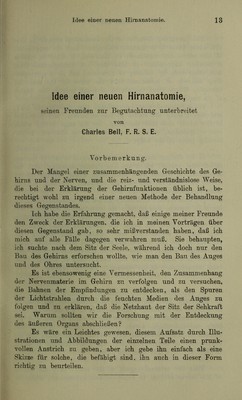
![The prevailing doctrine of the anatomical schools is, that the whole brain is a common sensorium; that the extremities of the nerves are organized, so that each is fitted to receive a peculiar impression; or that they are distinguished from each other only by delicacy of structure, and by a correspon- ding delicacy of sensation; that the nerve of the eye, for example, differs from the nerves of touch only in the degree of its sensibility. It is imagined that impressions, thus differing in kind, are carried along the nerves to the sensorium, and presented to the mind; and that the mind, by the same nerves which receive sensation, sends out the mandate of the will to the moving parts of the body. It is further imagined, that there is a set of nerves, called vital nerves, which are less strictly connected with the sensorium, or which have upon them knots, cutting off the course of sensation, and thereby excluding the vital motions from the government of the will. [5] This appears sufficiently simple and consistent, until we begin to examine anatomically the structure of the brain, and the course of the nerves, — then all is confusion: the divisions and subdivisions of the brain, the circuitous course of nerves, their intricate connections, their separation and re-union, are puzzling in the last degree, and are indeed considered as things inscrutable. Thus it is, that he who knows the parts the best, is most in a maze, and he who knows least of anatomy, sees least inconsistency in the commonly received opinion. In opposition to these opinions, I have to offer reasons for believing. That the cerebrum and cerebellum are different in function as in form; That the parts of the cerebrum have different functions; and that the nerves which we trace in the body are not single nerves possessing various powers, but bundles of different nerves, whose filaments are united for the convenience of distribution, but which are distinct in office, as they are in origin from the brain: That the external organs of the senses have the matter of the nerves adapted to receive certain impressions, while the](https://iiif.wellcomecollection.org/image/b24864985_0018.jp2/full/800%2C/0/default.jpg)