Further evidences of the skeleton in Deuterosaurus and Rhopalodon, from the Permian rocks of Russia / by H.G. Seeley.
- Harry Govier Seeley
- Date:
- 1894
Licence: Public Domain Mark
Credit: Further evidences of the skeleton in Deuterosaurus and Rhopalodon, from the Permian rocks of Russia / by H.G. Seeley. Source: Wellcome Collection.
Provider: This material has been provided by The Royal College of Surgeons of England. The original may be consulted at The Royal College of Surgeons of England.
3/66 (page 663)
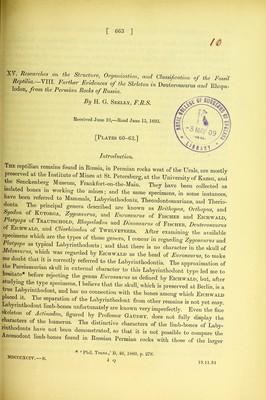
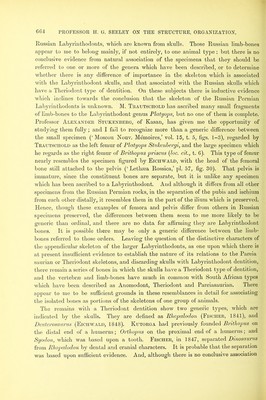
![XV. Researches on the Structure, Organization, and Classification of the Fossil Rep,Him —VIU. Further Evidences of the Skeleton in Deuterosaurus and Rhopa- lodon, from the Permian RocJcs of Russia. By H. G. Seeley, F.R.S. Received June 10,—Read June 15, 1893. [Plates 60-63.] Introduction. The reptilian remains found in Russia, in Permian rocks west of the Urals, ore mostly preserved at the Institute of Mines at St. Petersburg, at the University of Kazan, and the Senckenberg Museum, Frankfort-on-the-Main. They have been collected as isolated bones in working the mines; and the same specimens, in some instances, have been referred to Mammals, Labyrinthodon cs, Thecodontosaurians, and Therio- r, n ?' e principal genera described are known as Brithopus, Orthopus, and yoi on o UTORGA, Zygosaurus, and Eurosaurus of Fischer and Eichwald, R atyops of Trahtschold, Rhopalodon and Dinosaurus of Fischer, Deuterosaurus Eichwald, and Chorhuodm of Twelvetrees. After examining the available specimens which are the types of those genera, I concur in regarding Zygosaurus and Phityops as typical Labyrinthodonts; and that there is no character in the skull of Melosaurus which was regarded by Eichwald as the head of Eurosaurus, to make me doubt that it ,s correctly referred to the Labyrinthodontia. The approximation of hJ;r— m external character t0 tMs Labyrinthodont type led me to sh, 1 PfT rejectmS the £enus Eurosaurus as defined by Eichwald, but, after udying the type specimens, I believe that the skull, which is preserved at Berlin, is a n !! A 7’mu b’ ad haS n° connect!o11 the bones among which Eichwald Tab6 • iThe eparat1011 of tlle Labyrinthodont from other remains is not yet easy Labyrmthodont limb-bones unfortunately are known very imperfectly. Even the fine charaoT ° Iff0’ fi«urecl by Professor Gaudry, does not fully display the characters of the humerus. The distinctive characters of the limb-bones of Laby- mthodonts have not been demonstrated, so that it is not possible to compare the Anomodont limb-bones found in Russian Permian rocks with those of the larger MDCCCXCIV.—B. # ‘ Phil. Trans.,’ B, 46, 1889, p. 278. 4 Q 19.11.94](https://iiif.wellcomecollection.org/image/b22417308_0005.jp2/full/800%2C/0/default.jpg)