Further evidences of the skeleton in Deuterosaurus and Rhopalodon, from the Permian rocks of Russia / by H.G. Seeley.
- Harry Govier Seeley
- Date:
- 1894
Licence: Public Domain Mark
Credit: Further evidences of the skeleton in Deuterosaurus and Rhopalodon, from the Permian rocks of Russia / by H.G. Seeley. Source: Wellcome Collection.
Provider: This material has been provided by The Royal College of Surgeons of England. The original may be consulted at The Royal College of Surgeons of England.
48/66 (page 708)
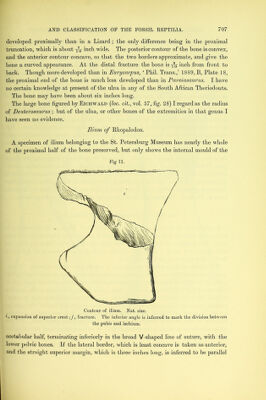
![to the vertebral axis, then the vertebral direction of the ilium is inclined a little backward. The superior blade is flat and smooth externally, and terminates in front in a some- what compressed margin which is moderately concave in depth, where it measures 3]uj inches. The depth from the posterior angle to the corresponding point of the ischial suture does not appear to have exceeded 2 inches. The posterior border is not perfectly preserved, and may have been a little wider than the specimen indicates in its present position. As preserved the transverse measurement across the w^aist of the bone is inch, and the transverse measurement at the ischio-pubic suture is 2-j^j inches. The posterior surface is evenly convex from side to side, and slightly convex from above downward in its lower half, but in the upper half it appears to be more concave in the thickened area which gave attachment to the sacral ribs. The remarkable point about this bone is that its vertical depth appears to greatly exceed the length of the crest ; while the bone agrees with other specimens in having the posterior border deeply concave, but appears to differ from other specimens in having the anterior margin sharply pointed. This will be evident by comparing the figure given below with that of the type previously described. It is a remarkable circum- stance that the diversity in form and proportion and character of the known remains of the pelvis and femur is greater than that in other parts of the skeleton. And these characters probably differentiate more species than can be established on modifica- tions of the skull. Provisionally these types may all be referred to Rhopalodon. The Femur of Rhopalodon and of Dinosaurus. A second type of femur, preserved in the Institute of Mines at St. Petersburg, is only known from the proximal end, and I regard it as indicating a bone about 6 inches long. The fragment preserved is 3 inches long, 2\ inches wide below the proximal articulation, and about 1 inch wide at the distal fracture, where it is -x%th inch thick. It is figured at plate Gl, figs. 3-6. The outline of the proximal articulation is convex from within outward. It con- sists of a transversely ovate articular cartilaginous area, more than an inch thick (fig. 6) which is prolonged outward and downward on the summit of the outward crest, which is flattened above and concave below. There is an inflation of the bone on the superior surface, below the thickened articulation (fig. 4). Both the inner and out er proximal margins are somewhat concave, but in such a way as to give the head of the bone an inward direction. The thick inner border is convexly rounded, and there is a similar rounding to the external margin of the shaft, which is more compressed. On the under side the area beneath the external crest is concavely excavated for a distance of about llr inch, and the excavation terminates in a prominent trochanter (figs. 3 and 5), which increases the thickness of the bone from Irf inch to 1 inch. The summit of this trochanter is an ovate tubercle, t', which is prolonged down the shaft as a](https://iiif.wellcomecollection.org/image/b22417308_0050.jp2/full/800%2C/0/default.jpg)