Further evidences of the skeleton in Deuterosaurus and Rhopalodon, from the Permian rocks of Russia / by H.G. Seeley.
- Harry Govier Seeley
- Date:
- 1894
Licence: Public Domain Mark
Credit: Further evidences of the skeleton in Deuterosaurus and Rhopalodon, from the Permian rocks of Russia / by H.G. Seeley. Source: Wellcome Collection.
Provider: This material has been provided by The Royal College of Surgeons of England. The original may be consulted at The Royal College of Surgeons of England.
53/66 (page 713)
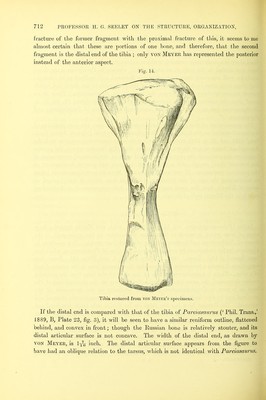
![Putting the two fragments together they give the form of the bone, which is here outlined, of the natural size. [Since this was written, Dr. F. Kinkelin has had the kindness to compare these fragments with each other. Finding them to unite, he has obligingly had a cast of the entire tibia made, and sent to me with casts of most of the other specimens figured by yon Meyee. These casts will be deposited in the British Museum.] Fibula of Rhopalodon. Eichwald figured in the ‘ Lethsea Rossica/ plate 57, fig. 29, a fragment of bone, 3f inches long, which I regard as probably the distal end of the fibula. That identification rests upon the curved form of the fibula, which was found resting upon the sacral region of the skeleton of Pareiasaurus Baini, and the similar evidence of curved form of the bone in the skeleton of a Dicynodon, with the bones preserved in natural association, from the Baavian’s river, preserved in the Albany Museum. The fibula in Pareiasaurus is large at the distal end. At the proximal end it is imperfect. It is necessarily shorter than the tibia in Pareiasaurus, owing to its different mode of union with the tarsus. Eichwald’s fragment at the distal end is 1-| inch wide, with a somewhat oblique and compressed articular surface, such as might have given attachment to the tarsus, and the fracture in the middle of the shaft gives a width of inch. The shorter tibial border is concave and inch long, as represented in the figure, while the moderately convex external border rather exceeds 3| inches. Among the fragments figured by von Meyer, c Palseontographica,’ plate 20, figs. 8, 9, 10, 11, is a small proximal end of a bone, broadly cordate in its proximal outline, with only 1^ inch of the shaft preserved. Its sides converge distally, on the hypothesis that it is a proximal end, and it terminates in a transverse ovate section if inch wide and -fa inch thick. There is a small proximal process developed. It is impossible to determine this bone with certainty without comparison; but its resemblance in thickness to the bone just mentioned, led me to regard it as a possible proximal end of the fibula. The Foot Bones of Rhopalodon. The only evidence of the extremities of the limbs is a single bone which Eichwald figures, plate 58, fig. 12. It was regarded by him as a phalange, and compared to the phalanges of Mastodonsaurus. It has the general aspect of a phalange of a Plesiosaur. The drawing indicates a bone l-^0- inch long, compressed from above downward, concave at the sides, expanded at the ends, with a transversely truncate surface at the proximal end, and a convex surface at the distal end. These ends are inch wide, and the bone is -24q inch wide in the middle. In proportion, it is similar 4 y 2](https://iiif.wellcomecollection.org/image/b22417308_0055.jp2/full/800%2C/0/default.jpg)