On food : four Cantor lectures, delivered before the Society for the Encouragement of Arts, Manufactures, and Commerce / by H. Letheby.
- Henry Letheby
- Date:
- 1868
Licence: Public Domain Mark
Credit: On food : four Cantor lectures, delivered before the Society for the Encouragement of Arts, Manufactures, and Commerce / by H. Letheby. Source: Wellcome Collection.
Provider: This material has been provided by The Royal College of Surgeons of England. The original may be consulted at The Royal College of Surgeons of England.
28/56 page 26
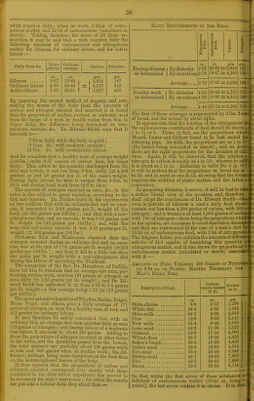
![adult requires daily, when at work, o'22oz. of nitro- genous matter and 22'38 of carbonaceous (calculated as starch). Taking, therefore, the mean of all those re- searches, it may bo said that a man requires daily the following amounts of carbonaceous and nitrogenous matter for idleness, for ordinary laboui-, and for active labour:— Daily Diets for Nitro- genous. Carbona- naceous. Carbon. Nitrogen. oz. oz. grs. grs. 2-67 16-83 ] ( 3,856 187 Ordinary labour i-56 24-48 ] = 6,757 319 Active laboiu'.. O'Sl 24-31 ) ( 6,837 400 By pursuing the second method of inquiry, and esti- mating the wants of the body from the amounts of carbon and nitrogen exhaled and secreted, it is found that the proportion of carbon evolved as carbonic acid from the lungs of a man in health varies from 6oz. to 13^02. daily, the difference being dependent on tem- perature, exercise, &c. Dr. Edward Smith says that it amoimts to— 7-85oz. daily while the body is quiet; 9-1 loz. do. with moderate exercise ; 12-9oz. do. with considerable labour. And he considers that a healthy man of average weight (1501bs.) emits 8-57 ounces of carbon from his lungs daily. This, added to the quantity discharged from the skin and bowels, is not less than 9-6oz. daily {= 4,200 grains) or just 28 grains per lb. of the man's weight. During light labour, ho says it ranges from 9'6oz. to 10-5, and during hard work from 12-5 to 14oz. The amount of nitrogen excreted as urea, &c., in the urine is also subject to great variation, according to the diet and exercise. Dr. Parkes found in his experiments on two soldiers, that with an ordinary diet and no exer- cise, it amounted to 2-03 grains per lb. weight of the body (= 304 grains per 150lbs.); and that with a non- nitrogenous diet, and no exercise, it was 0-95 grains per lb. weight {= 142 grains per 1501bs.); and with the same diet and active exercise it was 2-42 grains per lb. weight (= 364 grains per 150 lbs.). Professors Pick and WisHcenus ohserved that the nitrogen secreted during an ordinary diet and no exer- cise, was at the rate of 1-53 grains per lb. weight (=203 grains per 150 lbs.); and that it fell to a little less than one grain per lb. weight -with, a non-nitrogenous diet during the laboui- of ascending the Faulhom. The researches^ of the Eev. Dr. Haughton, of Dublin, have led him to conclude that an average-size man, per- forming routine work, secretes 187 grains of nitrogen as urea daily (= 1-25 grains per lb. weight); and Dr. Ed- word Smith has estimated it at from 0-93 to 1-4 grains per lb. weight—a fair average being 1-16 (= 173 grains per 150 lbs.). The more extensive inquii-ies of Playfair, Ranko, Beigel, Moos, Vogel, and others, give a diily average of 171 grains oi nitrogen as urea for a healthy man at rest, and 252 grains for ordinarj' labour. It may therefore bo safely concluded that with an ordinary diet, an average-size man excretes daily as urea 175 grains of nitrogen ; and during labour of a moderate description it amounts to about 250 grains. Adding to these the proportions of nitrogen excreted in other forms in the urine, and the quantities passed from the bowels the total amo\mts are probably about 190 grains while at rest, and 300 grains when at routine work ; tho dif- furenco, perhaps, being more dependent on the food than un tho metamorphosed tissues of tho body. It tluis appears that tho proportions of carbon and nitrog(!n excreted correspond very closoly witli those contained in the diets which experience has proved to be necessary for man'.s sustenance ; for when the results arc put into a tabular Ibnn they stand thus:— 1 D.^iLY Requiuements of tub Body. Nitrogenous Food. Carbonaceous Food. Carbon. g 2 a « y During idleness ( By dietaries as determined \ By excretions Average.... oz. 2-67 2-78 oz. grs. 10-83 = 3,85G 18-47 = 4,200 en. . 187: 190.' 2-72 17-65 = 4,028 188 > Routine work ( By dietaries as determined \ By excretions Average.... 4-56 4-39 -24-48 = 5,757 19-80 = 4,813 319 < 300.' 4-48 22-14 = 5,285 310 J The first of these averages is represented by 2 lbs. 2 ozKHr, of bread, and the second by about 3 Jibs. It appears also that the relation of the nitrogenous tdar,j the carbonaceous constituents of food should be about aJfcv 1 to 5^ or 6. These, in fact, are the proportions whictljj, Messrs. Lawes and G-Ubert found to be best suited finj fi fattening pigs. In milk, the proportions are as 1 to 3-(^ ], (the butter being calculated as starch) ; and no douM jf; these are the right proportions for the dietaries of chili ^ dren. Again, it will be observed, that the relation o nitrogen to carbon is nearly as 1 to 19; whereas in milt '- it is about as 1 to 11. Referring to table No. 4 (p. 617 ^ ''- it wUl be noticed that the proportions in bread are as ; [. to 22, and in meat as one to 13, showing that the forme- r: requires the addition of plastic matter, and the latter o l respiratory. : In preparing dietaries, however, it -will he best to takA c a rather liberal view of the question, and, therefore,. r. shall adopt the conclusions of Dr. Edward Smith—^than s- even in periods of idleness a man's daily food shonlil : contain not less than 4,300 grains of carbon, with 200 o J \\-. nitrogen; and a woman's at least 3,900 grains of carbon: :. with 180 of niti'ogen—these being the proportions which I -.. in his opinion, are necessary to avert starvation diseases :j i; and they are represented in the case of a man's diet b} I 19-25 oz. of carbonaceous food, with 2-84 of nitrogenou£J The diagram before you exhibits the amounts of dlfferen j c; articles of diet capable of furnishing this quantity o< •:; nitrogenous matter, and it also shows the proportions oi i cai-bonaceous matter (calculated as starch) associate with it:— Amounts of Food Yielding 200 Graiks of Nitkoobi OR 2-84 oz. of Plastic Matter Necessart foe . Man's Daily Diet. Description of Food. Carbon- aceous matter in it. Carbon in it. oz. oz. grs. 8-8 6-57 1,290 ■ 1 { White fish 24-6 6-99 1,384 t 94-1 8-96 2,059 < 1 12-6 9-33 2,141 • 1 91-4 9-40 2,160 18-3 11-36 2,629 22-9 17-54 4,000 :l moat-flour 26-7 19-28 4,433 Baker's bread 35-6 19-28 4,433 26-0 19-83 4,554 36-4 26-40 6,046 45-7 34-02 7,800 45-7 34-02 7,800 32-6 38-04 8,714 , So that, whilst the first seven of these substances a | deficient of carbonaceous matter (19-25 oz. being r 4 quired), tho last seven contain it in excess. It is, ■](https://iiif.wellcomecollection.org/image/b22280364_0028.jp2/full/800%2C/0/default.jpg)