On food : four Cantor lectures, delivered before the Society for the Encouragement of Arts, Manufactures, and Commerce / by H. Letheby.
- Henry Letheby
- Date:
- 1868
Licence: Public Domain Mark
Credit: On food : four Cantor lectures, delivered before the Society for the Encouragement of Arts, Manufactures, and Commerce / by H. Letheby. Source: Wellcome Collection.
Provider: This material has been provided by The Royal College of Surgeons of England. The original may be consulted at The Royal College of Surgeons of England.
53/56 (page 51)
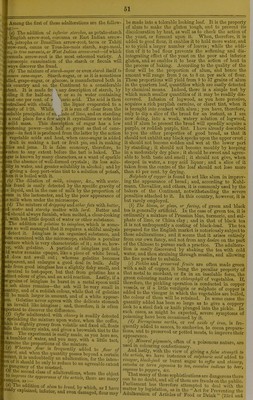
![1 Among the first of these adulterations arc the follow- a) The addition of inferior starches, as potato-starch English aiTOw-root, ciircuma or East Indian nrrow- ot, jatropha or Brazillian arrow-root, tacca or Tahiti w-root, canna or Tous-los-raois starch, sago-meal, to true maranta, or West Indian arrow-root—of which uda arrow-root is the most esteemed variety. _A croscopio examination of the starch or ffficula will iways discover the fraud. fbj The mistui-e of siareh-sugar or even starch itself to inon cane-sugar. Starch-sugar, or as it is sometimes ed, grape-sugar, or glucose, is manufactured both in is country and on the Continent to a considerable ;tent. It is made frc ■v any description of starch, by iling it for half-an-' ir or so in water containing out one per cent, of s luric acid. The acid is then lutralised with chalk, the liquor evaporated to a insity of 1'28. While , it is run off clear from the loluble precipitate of su. ^ jate of lime, and on standing a cool place for a few aays it crystallizes or sets into solid mass. This description of sugar has a low eetening power—not half so great as that of cane- gar—in fact it is produced from the latter by the action vegetable acids and heat, when cane-sugar is added fruit in making a tart or finiit pie, and in making lies and jams. It is false economy, therefore, to eeten to any extent before the tart is baked. The gar is known by many characters, as a want of sparkle im the absence of well-formed crystals ; its less solu- j 'ty in water, and greater solubility in alcohol; and by giving a deep port-wine tint to a solution of potash, en it is boiled with it. fcj The dilution of milk, vinegar, &c., with water. fraud is easily detected by the specific gravity of e liquid, and in the case of milk by the proportion of earn in the lactometer, and by the poor appearance of e milk when under the microscope. (dj The mixture of dripping and other fats with butter, d tvater and starchy matter with lard. Butter and d should always furnish, when melted, a clear-looking with but little deposit of water or other substance. The addition of gelatine to isinglass, which is some- es so well managed that it requires a skilful analysis detect it. Isinglass is an organised substance, and en examined with the microscope, exhibits a peculiar -.ctiu-o which is very characteristic of it; not so, how- •, with gelatine. A particle of isinglass put into Id water remains opaque, like a piece of white bread, id does not swell out; whereas gelatine becomes [ansparent, and enlarges a good deal in bulk. Jelly ade from good isinglass has a slightly fishy smell, and neutral to test-paper, but that from gelatine has a Istmct odoui- of glue, and an acid reaction. Lastly, if a grains of isinglass bo burnt in a metal spoon until c ash alone remains—tho ash will be very small in antity, and of a reddish colour-, while that of gelatine [ill bo much larger in amount, and of a white appear- _ Gelatine never agi-ees with tho delicate stomach an invalid like isinglass ; and, therefore, it is often portant to discover the difl'erencc. ffj Coffee adulterated with chicory is readily detected sprinkling the mixture upon water, when the coffee, hicb 18 slightly greasy from volatile and fixed oil, fioats tule the chicory sinks, and gives a brownisli tint to the later, ihe experiment is easily made, as you here see, 1. a tumbler of water, and you may, with a little tact, •termme the proportions of the mixture. {g) Whealen four is frequently added to flour of ustard and when the quantity passes beyond a certain inn T!. undoubtedly an adulteration, for tho inten- m nnni '^^I'l,.^^ to reduce to an agreeable extent 10 pungency ot the mustard. to .SL'f/^*^ °^ diiHcrations, whero tho object icampks, as •- -^ '■'•<^. t^^ero are many IrSdy cioffiior-°f *° ^« I l^'^ve jieaay explained, infenor, and oven damaged, fioiurmay lice be made into a tolerable looking loaf. It is the property of alum to make tho gluten tough, and to prevent its discolouration by heat, as well as to check the action of the yeast, or ferment upon it. When, therefore, it is added to good flour, it enables it to hold more water, and so to yield a larger number of loaves; while the addi- tion of it to bad flour prevents tho softening and dis- integrating effect of tho yeast on tho poor and inferior gluten, and so enables it to bear tho action of heat in tho process of baking. According to tho quality of the flour wUl be the proportion of alum, and hence the amount will range from 2 oz. to 8 oz. per sack of flour. These proportions will yield from 9 to 37 grains of alum in the quai'tern loaf, quantities which are easily detected by chemical means. Indeed, there is a simple test by which much smaller quantities of it may be readily dis- covered. Infusion of logwood, as you here perceive, acquires a rich purplish carmine, or claret tint, when it is brought into contact with alum; you have, therefore, only to dip a slice of the bread for an instant, as I am now doing, into a weak, watery solution of logwood, and if alum be present the bread will speedUy acquire a purple, or reddish purple, tint. I have already described to you the other properties of good bread, as that it should not exhibit any black specks upon the upper crust; it shoidd not become sodden and wet at the lower part by standing; it should not become mouldy by keeping in a moderately dry place; it should be sweet and agree- able to both taste and smeU; it should not give, when steeped in water, a ropy acid liquor; and a slice of it taken from the centre of the loaf should not lose more than 45 per cent, by drying. Sulphate of copper is found to act Uke alum in improv- ing the appearance of bread; and, according to Kuhl- mann, Chevallier, and others, it is commonly used by the bakers^ of the Continent, notwithstanding the severe penalties attached to it. In this country, however, it is but rarely employed. (J) The bloom, or glaze, or facing, of green and black tea is generally artificial. In the case of green tea, it is ordinarily a mixture of Prussian blue, turmeric, and sul- phate of Ume, or China clay; and in that of black tea it is not unfrequently a coating of black-lead. The tea prepared for the English market is notoriously subject to these adulterations; and it seems that it arises entirely fr'om our own fancy, and not from any desire on the part oi the Chinese to pursue such a practice. The adultera- tion is easily discovered by shaking the tea with cold water, and then straining through muslin, and aUowing the fine powder to subside. _{c) Fickles and preserved fruits are often made green with a salt of copper, it being the peculiar property of that metal to mordant, or fix in an insoluble form, the green colouring matter or chlorophyll of vegetables. If, therefore, tho pickling operation is conducted in copper vessels, or if a little verdigris or sulphate of copper is added to the vinegar in which the vegetables are boiled, , tho colour of them will be retained. In some cases the] quantity added has been so largo as to give a coppery! look to a steel fork or knife plunged into the pickle. In' such cases, as might be expected, severe symptoms of poisoning have been occasioned by it. fdj Ferruginous earths, or red oxide of iron, is fro- quently added to sauces, to anchovies, to cocoa prepara- tions, and to preserved or potted moats, to improve their appearance. (e) Mineral pigments, often of a poisonous nature, aro used in colouring confectionary. And lastly, with tho view of giving a false strength to the article, wo have instimces of sulphuric acid added to vinegar, black-jack or burnt sugar to cofce and chicory, catechu or terra japonica to tea, cocciUus indicus to beer, cayenne to 2)eppers, tfcc. That many of tliose sophistications aro dangerous thoro can be no doubt, and all of thorn are frauds on the public, larhaincnt lias therefore attempted to deal with tho matter by legislation, as in tho Act for Preventing tho Adulteration of ArUcles of Food or Drink (23rd and](https://iiif.wellcomecollection.org/image/b22280364_0053.jp2/full/800%2C/0/default.jpg)