Illustrations and enquiries relating to mesmerism. Part I / By the Rev. S.R. Maitland.
- Samuel Roffey Maitland
- Date:
- 1849
Licence: Public Domain Mark
Credit: Illustrations and enquiries relating to mesmerism. Part I / By the Rev. S.R. Maitland. Source: Wellcome Collection.
89/90 page 81
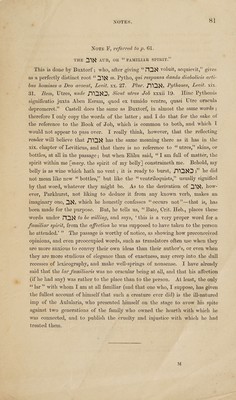
![Note F, referred to p. 61. THE nw ATTB, OR “FAMILIAR SPIRIT.” This is done by Buxtorf; who, after giving “ PO& voluit, acquievit,” gives as a perfectly distinct root “ m- Pytho, qui responsa dando diabolicis arti- bus homines a Deo avocat, Levit. xx. 27. Plur. JTON, Dgthones, Levit. xix. 31. Item, Utres, unde Sicut utres Job xxxii 19. Hinc Pythonis significatio juxta Aben Esram, quod ex tumido ventre, quasi Utre oracula. depromeret.” Castell does the same as Buxtorf, in almost the same words ; therefore I only copy the words of the latter ; and I do that for the sake ot the reference to the Book of Job, which is common to both, and which I would not appear to pass over. I really think, however, that the reflecting reader will believe that has the same meaning there as it has in the xix. chapter of Leviticus, and that there is no reference to cc utres,” skins, or bottles, at all in the passage; but when Elihu said, “ I am full of matter, the spirit within me [marg. the spirit of my belly] constraineth me. Behold, my belly is as wine which hath no vent ; it is ready to burst, JTQiO ke did not mean like new “ bottles*” but like the “ ventriloquists,” usually signified by that word, whatever they might be. As to the derivation of how¬ ever, Parkhurst, not liking to deduce it from any known verb, makes an imaginary one, na, wilick he honestly confesses “occurs not”—that is, has been made for the purpose. But, he tells us, “ Bate, Crit. Heb., places these words under ma to be willing, and says, c this is a very proper word for a familiar spirit, from the affection he was supposed to have taken to the person he attended.’ ” The passage is worthy of notice, as showing how preconceived opinions, and even preoccupied words, such as translators often use when they are more anxious to convey their own ideas than their author’s, or even when they are more studious of elegance than of exactness, may creep into the dull recesses of lexicography, and make well-springs of nonsense. I have already said that the lar familiaris was no oracular being at all, and that his affection (if he had any) was rather to the place than to the person. At least, the only “ lar ” with whom I am at all familiar (and that one who, I suppose, has given the fullest account of himself that such a creature ever did) is the ill-natured imp of the Aulularia, who presented himself on the stage to avow his spite against two generations of the family who owned the hearth with which he was connected, and to publish the cruelty and injustice with which he had treated them. M](https://iiif.wellcomecollection.org/image/b30374479_0089.jp2/full/800%2C/0/default.jpg)
 No text description is available for this image
 No text description is available for this image
 No text description is available for this image