A voyage from England to India, in the year MDCCLIV. And an historical narrative of the operations of the squadron and army in India, under the command of Vice-Admiral Watson and Colonel Clive in the years 1755, 1756, 1757; including a correspondence between the admiral and the nabob Serajah Dowlah ... Also, a journey from Persia to England, by an unusual route. With an appendix, containing an account of the diseases prevalent in Admiral Watson's squadron: description of most of the trees, shrubs, and plants of India ... also a copy of a letter written by a late ingenious physician, on the disorders incidental to Europeans at Gombroon in the Gulph of Persia ... / By Edward Ives.
- Edward Ives
- Date:
- 1773
Licence: Public Domain Mark
Credit: A voyage from England to India, in the year MDCCLIV. And an historical narrative of the operations of the squadron and army in India, under the command of Vice-Admiral Watson and Colonel Clive in the years 1755, 1756, 1757; including a correspondence between the admiral and the nabob Serajah Dowlah ... Also, a journey from Persia to England, by an unusual route. With an appendix, containing an account of the diseases prevalent in Admiral Watson's squadron: description of most of the trees, shrubs, and plants of India ... also a copy of a letter written by a late ingenious physician, on the disorders incidental to Europeans at Gombroon in the Gulph of Persia ... / By Edward Ives. Source: Wellcome Collection.
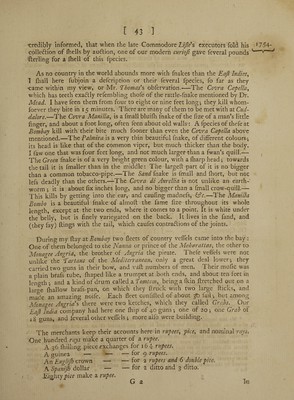
![\ [ 43 ] credibly informed, that when the late Commodore executors fold his ^754* cplleftion of fhells by auflion, one of our modern curiofi gave feveral pounds '—“v— ilerling for a fhell of this fpecies. As no country in the world abounds more with fnakes than the Eaji Indies^ I fhall here fubjoin a defcription or their feveral fpecies, fo far as they •came within my view, or Mr. Thomas's obfervation.—The Covra Cafella^ which has teeth exactly refembhng thofe of the rattle-fnake mentioned by Dr. Mead. I have feen them from four to eight or nine feet long-, they kill whom- foever they bite in 15 minutes. There are many of them to be met with at Cud- dalore.—The Covra Manilla^ is a fmall bluifh fnake of the fize of a man’s little finger, and about a foot long, often feen about old walls: A fpecies of thefe at Bombay kill with their bite much fooner than even the Covra Capella above mentioned.—The Palmira is a very thin beautiful fnake, of different colours^ its head is like that of the common viper, but much thicker than the body. I faw one that was four feet long, and not much larger than a fwan’s quill.— , The Green fnake is of a very bright green colour, with a fliarp head; towards the tail it is fmaller than in the middle: The largefl part of it is no bigger than a common tobacco-pipe.—The Sand fnake is fmall and fhort, but not lefs deadly than the others.—The Covra de Aurellia is not unlike an earth-' worm ; it is about fix inches long, and no bigger than a fmall crow-quill.— ' This kills by getting into the ear, and caufing madnefs, i^c.—The Manilla Bomho is a beautiful fnake of almoft the fame fize throughout its whole leno-th, except at the two ends, where it comes to a point. It is white under the belly, but is finely variegated on the back. It lives in the fand, and (they fay) flings with the tail, which caufes contradions of the joints. During my flay at Bombay two fleets of country veflfels came into the bay: One of them belonged to the Nanna or prince of the Maharattas., the other to Monagee Angria^ the brother of Angria the pirate. Thefe vefiels were not unlike the Tartans of the Mediterranean., only a great deal lower; they carried two guns in their bow, and vaft numbers of men. Their mufic was a plain brafs tube, fhaped like a trumpet at both ends, and about ten feet in ieno-th ; and a kind of drum called a Tomtemy being a flcin ftretched out on a lar(?e fhallow brafs-pan, on which they ftruck with two large flicks, and made an amazing noife. Each fleet confifled of about ^ fail; but among Mcnagee Angria s there were two ketches, which they called Crabs. Our ~EaJi India company had here one fhip of 40 guns; one of 20; one Grab of 18 guns, and feveral other veflTcls; more aifo were building. • The merchants keep their accounts here in rupees.^ pice., and nominal rays. One hundred rays make a quarter of a rupee. A 36 (hilling piece exchanges for 16^ rupees. A guinea — — — for 9 rupees. An Englijh Qvov^n — — for 2 rupees and 6 double pice. A Spanijh dollar — — for 2 ditto and 3 ditto. Jiighty^/r^ make a rupee.](https://iiif.wellcomecollection.org/image/b30410678_0065.jp2/full/800%2C/0/default.jpg)