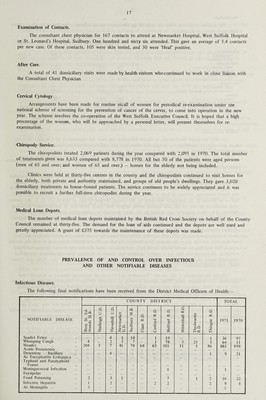
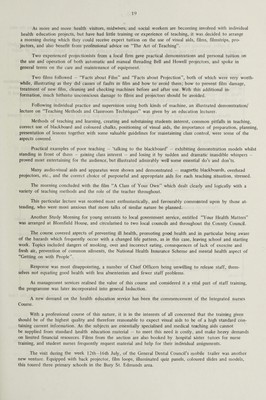
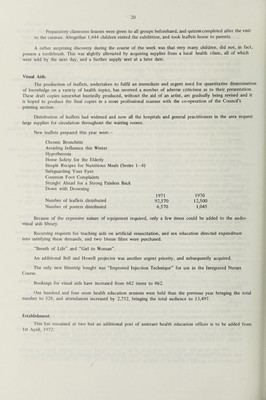
[Report 1971] / School Medical Officer of Health, West Suffolk County Council.
- West Suffolk (England). County Council.
- Date:
- 1971
Licence: Attribution 4.0 International (CC BY 4.0)
Credit: [Report 1971] / School Medical Officer of Health, West Suffolk County Council. Source: Wellcome Collection.
24/28 (page 22)
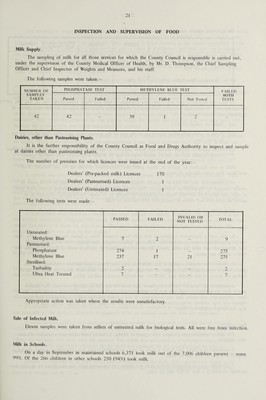
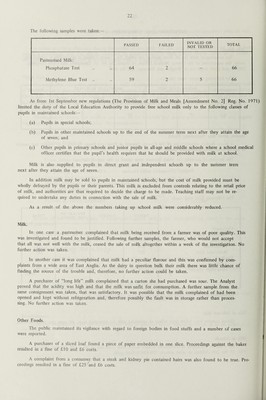
![The following samples were taken:— PASSED FAILED INVALID OR NOT TESTED TOTAL Pasteurised Milk: Phosphatase Test 64 2 — 66 Methylene Blue Test 59 2 5 66 As from 1st September new regulations (The Provision of Milk and Meals [Amendment No. 2] Reg. No. 1971) limited the duty of the Local Education Authority to provide free school milk only to the following classes of pupils in maintained schools: — (a) Pupils in special schools; (b) Pupils in other maintained schools up to the end of the summer term next after they attain the age of seven; and (c) Other pupils in primary schools and junior pupils in all-age and middle schools where a school medical officer certifies that the pupil’s health requires that he should be provided with milk at school. Milk is also supplied to pupils in direct grant and independent schools up to the summer term next after they attain the age of seven. In addition milk may be sold to pupils in maintained schools, but the cost of milk provided must be wholly defrayed by the pupils or their parents. This milk is excluded from controls relating to the retail price of milk, and authorities are thus required to decide the charge to be made. Teaching staff may not be re¬ quired to undertake any duties in connection with the sale of milk. As a result of the above the numbers taking up school milk were considerably reduced. Milk. In one case a pasteuriser complained that milk being received from a farmer was of poor quality. This was investigated and found to be justified. Following further samples, the farmer, who would not accept that all was not well with the milk, ceased the sale of milk altogether within a week of the investigation. No further action was taken. In another case it was complained that milk had a peculiar flavour and this was confirmed by com¬ plaints from a wide area of East Anglia. As the dairy in question bulk their milk there was little chance of finding the source of the trouble and, therefore, no further action could be taken. A purchaser of “long life” milk complained that a carton she had purchased was sour. The Analyst proved that the acidity was high and that the milk was unfit for consumption. A further sample from the same consignment was taken, that was satisfactory. It was possible that the milk complained of had been opened and kept without refrigeration and, therefore possibly the fault was in storage rather than proces¬ sing. No further action was taken. Other Foods. The public maintained its vigilance with regard to foreign bodies in food stuffs and a number of cases were reported. A purchaser of a sliced loaf found a piece of paper embedded in one slice. Proceedings against the baker resulted in a fine of £10 and £6 costs. A complaint from a consumer that a steak and kidney pie contained hairs was also found to be true. Pro¬ ceedings resulted in a fine of £25 and £6 costs.](https://iiif.wellcomecollection.org/image/b30264182_0024.jp2/full/800%2C/0/default.jpg)